How to Follow Up a Direct Mail Campaign With Email Marketing
Sending a direct mail campaign without a follow-up email sequence is like making a sales call and hanging up before leaving a message. The mail piece does the hard work of getting attention — but most conversions happen after the second or third touchpoint. This guide covers the exact timing, subject lines, and email-by-email structure that turn physical mail into a two-channel campaign with measurably better results.
Key Findings
- Combining direct mail with email produces a 118% lift in overall response rates compared to direct mail alone, per 2025/2026 ANA/DMA data.
- Adding a coordinated email follow-up generates approximately 20% more consumer spending beyond the direct mail baseline.
- The first follow-up email should go out 2 to 3 days after confirmed delivery — not before the mail piece arrives.
- Sending four or more emails in a compressed window triples unsubscribe and spam complaint rates.
- Subject lines that explicitly reference the physical mail piece outperform generic subject lines across both B2B and B2C campaigns, in some cases by double-digit open rate differences.
Why Timing Is Everything
The entire logic of a direct mail and email combination depends on one thing: the email arrives after the mail piece, not before it. When the sequence is reversed — when an email goes out referencing a postcard that hasn't arrived yet — the email reads as noise. The recipient has no context. The psychological bridge you're trying to build between the physical piece and the digital follow-up simply doesn't exist yet.
The same problem applies in reverse. If you wait too long after delivery, the mail piece has been recycled, the offer has faded from memory, and the email feels random. Direct mail stays in the average household for 17 days and gets revisited around five times during that window. Your follow-up sequence needs to land while the piece is still physically present.
The practical challenge: you can't always know exactly when a piece was delivered. USPS First Class mail delivers in 3 to 5 days. Standard/Marketing Mail takes 3 to 10 days. If you're using a platform like Lob or PostGrid, their USPS tracking API can tell you the moment a piece is scanned as delivered. If you're using a traditional mail house, you'll estimate based on drop date plus average delivery time for your mail class.
USPS Informed Delivery adds an additional timing layer worth knowing: opted-in subscribers receive a grayscale scan of incoming mail by email — sometimes the evening before physical delivery. If you run an Informed Delivery interactive campaign alongside your mail drop, you get a pre-arrival digital impression as a bonus touchpoint. Read our direct mail GA4 tracking guide for full setup details. For this article, we'll focus on what happens after delivery.
The Widening Gap Cadence
The most common mistake in post-mail email sequences is front-loading too many messages too fast. Three emails in five days feels like pressure. It signals automation, not intent. Mailbox providers track what they call a "disaffection index" — a composite metric combining unsubscribes, spam complaints, and hard bounces. Aggressive frequency spikes this index and can damage domain reputation permanently.
The better approach is a widening gap sequence. The first email goes out quickly to capture high intent. Each subsequent email gives the recipient more space. The sequence mimics how a persistent but respectful person follows up — close at first, then progressively less frequent.
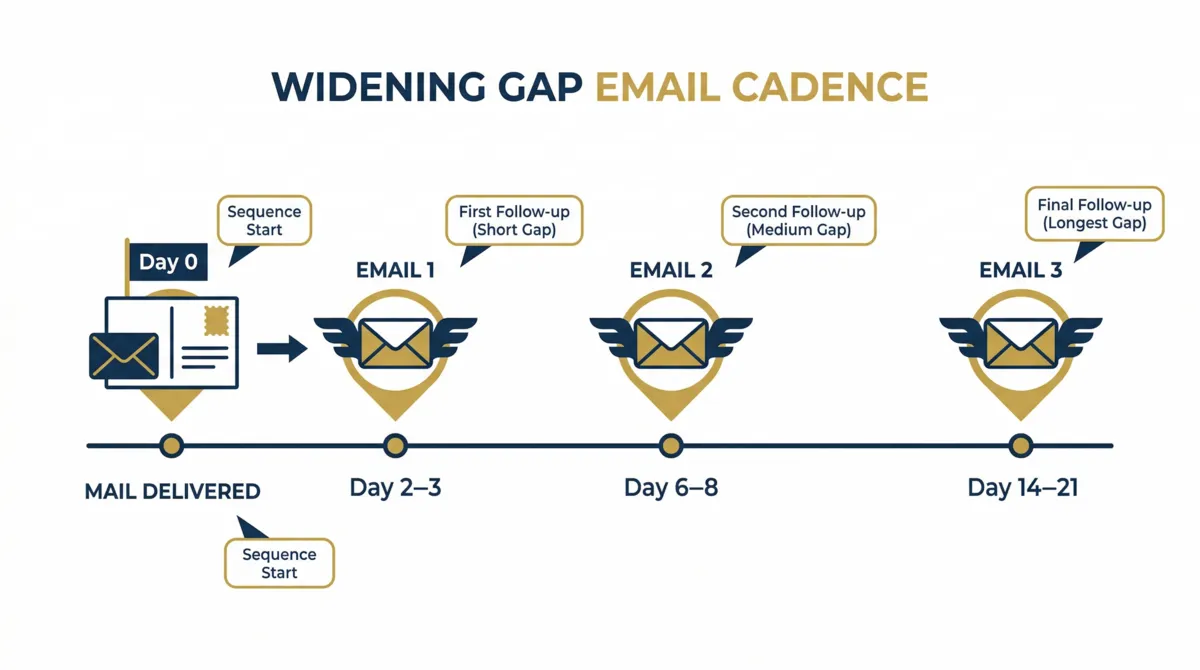
Email 1 — Day 2 to 3 Post-Delivery
This is your highest-urgency send. The mail piece just arrived. The offer is fresh. Keep this email short: one reference to the mailer, one value point, one clear call to action. The goal is to convert the recipients who were already interested but hadn't acted yet.
Email 2 — Day 6 to 8 Post-Delivery
The second send expands the value. Add something the mail piece didn't include: a relevant statistic, a short customer story, a comparison, or a secondary offer. This email should feel like a natural extension of the original message — not a repeat of it. Recipients who didn't open Email 1 get a second chance with a different subject line angle.
Email 3 — Day 14 to 21 Post-Delivery
The third email shifts register. Drop the sales pressure. Offer something useful — a checklist, a resource, a short insight relevant to the original offer. This is a nurture email, not a closing email. It keeps your brand in the conversation without demanding action, and it plants a flag for recipients who may convert on a longer timeline.
| Send | Timing | Purpose | Ideal Length |
|---|---|---|---|
| Email 1 | Day 2–3 post-delivery | Capture immediate intent | 100–150 words |
| Email 2 | Day 6–8 post-delivery | Expand value, new angle | 150–200 words |
| Email 3 | Day 14–21 post-delivery | Long-term nurture | 100–150 words |
Subject Lines That Reference the Mail Piece
Research across more than 85,000 email sequences shows that 64% of recipients decide whether to open an email based on the subject line alone. For post-direct-mail sequences, that decision is heavily influenced by one variable: does the subject line tell the recipient this email is connected to something they already have in their hands?
Explicitly referencing the physical mail piece does two things. First, it separates the email from generic inbox noise — because no other sender can claim to have mailed something to this person. Second, it subconsciously prompts the recipient to go find the piece if they haven't opened it yet, which increases the mail response rate in addition to the email open rate.
Subject Line Structures That Work
| Campaign Type | Subject Line Templates | Why It Works |
|---|---|---|
| B2C Postcard / Offer | "Check your mailbox — we sent you something" | "Your [offer] just arrived" | Creates intrigue before recipient recalls the piece; prompts physical retrieval |
| B2B Dimensional Mail | "Did you receive the package we sent?" | "Quick question about the [item] on your desk" | Dimensional mail occupies physical space — referencing it creates immediate recall and conversational obligation |
| Catalog / Report Mailer | "Here's the digital copy of what we mailed you" | "A follow-up on the data we sent over" | Bridges the printed piece to a digital action; creates continuity rather than a cold ask |
| Abandoned Cart Escalation | "We sent a special delivery about your cart" | "Check your mailbox — there's something waiting" | Injects physical novelty into standard e-commerce recovery; breaks the digital-only fatigue pattern |
| Event / Seasonal Campaign | "Following up on the invite we mailed" | "The sale on your fridge starts tomorrow" | References the retained physical reminder; uses the household placement as an advantage |
Subject Line Length and Deliverability
Mobile devices account for 55% of all email opens. Subject lines over 50 characters get truncated on most phone screens. Data from 2025/2026 email benchmark reports shows that subject lines of 50 characters or fewer achieve 12% higher open rates and 75% higher click-through rates compared to longer lines.
Avoid spam-flagged language: "100% Free," excessive caps, "Act Now," or multiple exclamation points. Modern mailbox providers algorithmically penalize these patterns, routing emails to promotional tabs or spam folders before a human ever sees the subject line.
B2B vs B2C Follow-Up Sequences
The timing rules above apply to both contexts — but the content, tone, and channel mix differ substantially between B2B and B2C campaigns.
B2B — Especially Dimensional or High-Value Mailers
In B2B, the target is often a decision-maker receiving 200 to 400 emails daily. Cold digital outreach has a 98% ignore rate at that level. A dimensional mailer — a branded package, a custom box, a premium item — achieves initial response rates between 12% and 15% because it lands on a physical desk and demands attention.
The email follow-up for B2B dimensional mail works best as part of a multi-step sequence that includes more than just email:
- 1Day 1 — Mail piece deliveredThe dimensional mailer arrives. No email yet.
- 2Day 3 — First email"Did you receive the package we sent?" Short, conversational, no pitch. One sentence about why you sent it.
- 3Day 7 — LinkedIn connection requestConnect with a short note referencing the mailer. The multi-channel presence is the point.
- 4Day 10 — Second emailA relevant case study or data point. Not a product pitch — a useful insight connected to the original mailer theme.
- 5Day 14 — Phone call or voicemailA brief, human message. Reference the mailer and the emails. Ask for 15 minutes.
This multi-channel B2B sequence achieves a 6% to 10% meeting conversion rate, compared to 2% to 3.5% for email-only outreach at the same target level.
B2C — Postcard, Self-Mailer, and Catalog Campaigns
B2C sequences run faster, at higher volume, and focus primarily on offer conversion. The email isn't a relationship-builder — it's a conversion accelerator for recipients who noticed the mail piece but didn't act immediately.
Key differences from B2B:
- Sequences can be fully automated without personalization beyond first name and offer details
- The second email can introduce urgency (offer expiration, limited availability) that would feel too aggressive in B2B
- Abandoned cart recovery works well here: mail piece arrives → recipient visits site but doesn't purchase → automated email sequence triggers referencing both the mailer and the abandoned session
- Seasonal campaigns flip the sequence: email first to announce the upcoming mail drop, then the follow-up email after delivery
What to Write in Each Email
The connective tissue between the mail piece and each email is the reference point — the specific thing you mention that tells the recipient this email is a continuation of something they already received, not a cold outreach.
Email 1 — The Connector
Open with the reference. Don't bury it. The first sentence should make the connection explicit: "Last week we mailed you [description of the piece]." Then one sentence on why: the offer, the event, the insight. Then one clear call to action. Keep the entire email under 150 words. This email's job is conversion for the already-interested — not persuasion.
Subject: [Mail reference] — following up
Hi [First Name],
Last week we sent you [description of mail piece].
[One sentence on the offer or reason.]
[Single CTA — link or reply ask]
[Signature]
Email 2 — The Expander
Don't repeat Email 1. Add something new: a relevant data point, a short customer outcome, a secondary benefit, or a comparison. This email is for recipients who are considering but need more. It should feel like a natural follow-up from a human who anticipated their hesitation and addressed it proactively.
Email 3 — The Nurturer
Remove the hard ask. Offer something genuinely useful — a guide, a checklist, a short tip — that's relevant to the original mailer topic. Close with a low-pressure option: "If you're still thinking it over, reply and I'll send over more details." This email keeps the door open without pushing it.
Best Days and Times to Send
The timing of the sequence relative to delivery matters most. But the actual clock time of each send also affects whether emails get opened or buried.
Data from analysis of over 85,000 email sequences points to consistent patterns for B2B outreach. The best-performing send windows are Tuesday through Thursday, between 8:00 AM and 11:00 AM or between 1:00 PM and 3:00 PM in the recipient's local time zone. These windows align with what researchers call "cognitive execution phases" — periods when professionals are actively working through tasks rather than managing inbox backlog (Monday morning) or winding down (Friday afternoon).
| Quarter | B2B Follow-Up Response Rate | B2C Follow-Up Response Rate | Context |
|---|---|---|---|
| Q1 (Jan–Mar) | 3.5%–4.0% | 2.5%–3.0% | High B2B budget activity; low post-holiday B2C discretionary spend |
| Q2 (Apr–Jun) | 4.0%–4.5% | 2.5%–3.0% | Peak B2B procurement period; stable B2C engagement |
| Q3 (Jul–Sep) | 3.5%–4.0% | 2.5%–3.5% | Summer B2B slowdowns; back-to-school B2C activity |
| Q4 (Oct–Dec) | 3.0%–3.5% | 4.0%–6.0% | B2B year-end fatigue; B2C holiday transaction peak |
For B2C campaigns, send timing is less sensitive to day of week and more sensitive to offer expiration windows. If a postcard offer expires on a specific date, the Email 1 send should be timed so recipients have at least 48 to 72 hours to act before the deadline. Email 2 arrives 24 hours before expiry as a final reminder.
Email Sequence Planner
Enter your mail drop date and mail class. The planner calculates your estimated delivery date and the three recommended email send dates based on the widening gap cadence.
Direct Mail Follow-Up Sequence Planner
Enter your drop date and mail class to get your recommended send schedule.
Tracking Who Responds to Your Follow-Up Emails
Your email platform already tracks opens and clicks by contact. The added layer for direct mail follow-up sequences is connecting that email engagement data back to your original mailing list.
The Mail-Email Overlap Segment
After your sequence runs, export two lists from your email platform: everyone who received the sequence, and everyone who opened at least one email. Cross-reference those against your original mailing list. The contacts who appear in all three — received the mail piece, received the email, opened the email — are your highest-intent group. They've had two brand touchpoints and voluntarily engaged with at least one. These people warrant direct follow-up by phone or a personalized one-to-one email, separate from the automated sequence.
UTM Tagging Every Link
Every link in every follow-up email should carry UTM parameters that distinguish it from other traffic sources. Use utm_medium=email, utm_source=direct_mail_followup, and utm_campaign=[your campaign name]. This lets GA4 show you exactly which email in the sequence drove conversions — and whether the email follow-up or the original mail piece was the last touchpoint before a purchase.
For full GA4 attribution setup including UTM builders and custom channel groups, see our direct mail GA4 tracking guide.
Matchback Analysis — The Bigger Picture
Some recipients will receive your mail piece and follow-up emails, then convert by going directly to your website — with no UTM parameter, no QR scan, no code redemption. They just typed your URL or searched your brand. This traffic shows up in GA4 as "(direct)" or organic, and the conversion appears to have nothing to do with your campaign.
Matchback analysis corrects this. The process: after a campaign closes, export all conversions from every channel — web purchases, inbound calls, form submissions — over a 30 to 90 day window. Cross-reference those names and addresses against your original mailing list. Any conversion from someone on the mailing list gets attributed to the campaign, regardless of how they converted. This typically reveals that direct mail's actual influence on total conversions is 30% to 50% higher than UTM-only tracking shows.
Case Studies
Arnold Electrical Services — CRM List + Synchronized Digital Ads
2,851% ROIThis Chicago electrical firm mailed 2,500 postcards from their existing CRM list, featuring personalized copy and photos of the local team. The physical campaign ran alongside synchronized digital retargeting. The combined approach — physical mail establishing credibility, digital ads maintaining visibility — generated 20 direct responses. Ten of those converted into jobs, producing $45,000 in closed work against a $1,525 investment.
The lesson: an existing CRM list outperforms a cold purchased list because recipients already have brand familiarity. The email follow-up sequence amplifies this by referencing a relationship the recipient already has with the business.
thredUP — A/B Testing Physical Copy With Digital Attribution
+128% ROI liftthredUP ran a dormant customer reactivation campaign with two postcard variants, tracked via utm_content parameters. Version A carried a personalized CEO letter. Version B used a bulleted reasons list. Follow-up email sequences ran to both groups after delivery. GA4 attribution data showed the CEO letter variant drove measurably higher conversion — and that unsubscribed email customers converted at higher rates via direct mail than active email subscribers.
The attribution data didn't just measure the campaign. It reshaped who the team decided to mail next — shifting budget away from active email subscribers and toward lapsed contacts who were unreachable through email alone.
McAdoo Estate Planning — QR + Email RSVP Sequence
464% ROIThis financial services firm mailed 6,000 pieces promoting a free educational workshop, using a QR code for digital RSVP. When a prospect scanned and visited the landing page but didn't complete registration, an automated email sequence triggered within 24 hours — referencing both the mailer and the incomplete RSVP. The physical hook ("What happens to your house when you die?") was carried into the email subject line, maintaining the psychological thread across channels.
35 qualified leads attended the workshop. Three converted into full advisory clients. The campaign produced a 464% return on total spend — illustrating how high-value B2B/B2C hybrid markets benefit disproportionately from physical mail paired with smart email follow-up.
Frequently Asked Questions
Wait until the mail piece has physically arrived — 2 to 3 days after confirmed or estimated delivery. Sending before arrival breaks the contextual connection and the email reads as generic outreach. If you're using a platform like Lob or PostGrid, their USPS tracking webhook can trigger the first email automatically when a piece scans as delivered.
Three is the standard cadence: one at 2–3 days post-delivery, one at 6–8 days, and one at 14–21 days. Sending four or more emails in a compressed window more than triples unsubscribe and spam complaint rates, according to 2025/2026 industry data. Quality and timing matter more than volume.
Explicitly reference the physical mail piece. For B2C, something like "Check your mailbox for [offer]" or "Following up on what we sent you" consistently outperforms generic subject lines. For B2B dimensional mail, a direct question like "Did you receive the package we sent?" works well because the physical object is memorable. Keep subject lines under 50 characters to avoid truncation on mobile.
Yes. According to ANA/DMA 2025/2026 Response Rate Reports, combining direct mail with email produces a 118% lift in overall response rates compared to direct mail alone. Adding a coordinated email follow-up also generates approximately 20% more consumer spending beyond the direct mail baseline. The two channels reinforce each other — the physical piece builds credibility, the email provides a frictionless path to action.
Your email platform tracks opens and clicks by contact. Export that list and cross-reference it against your original mailing list. The overlap — people who received the mail piece AND opened at least one email — is your highest-intent segment. These contacts should get direct, personalized follow-up separate from the automated sequence.
Yes, substantially. B2B sequences — especially for high-value dimensional mail — are slower, more personalized, and often include LinkedIn touches and phone calls alongside email. B2C sequences are faster, higher volume, and focused on offer expiration and conversion mechanics. Both use the same widening gap cadence, but the content, tone, and channel mix differ.