The Complete Trade Show Marketing Checklist for Small Business
A trade show booth costs a small business anywhere from $5,000 to $15,000 once you add space rental, display hardware, travel, and shipping. Most of that money gets wasted — not because the show was wrong, but because the preparation was rushed, the lead capture was paper-based, and the follow-up emails went out five days too late. This checklist covers everything from the 12-week planning timeline to the 48-hour post-show window that determines whether the investment converts.
Key Findings
- Companies report an average ROI of $20.98 for every dollar spent on trade show marketing, per 2025/2026 CEIR and ANA/DMA data.
- 81% of trade show attendees have purchasing authority or direct buying influence — one of the highest-density decision-maker environments in B2B marketing.
- Leads contacted within 24 hours are 7x more likely to convert than those reached later. Most competitors wait until the following week.
- 12 weeks is the minimum viable prep window. Less than that means rush fees, poor booth placement, and untrained staff.
- Drayage, electrical drops, and venue Wi-Fi are the three hidden costs that most commonly blow first-time exhibitor budgets by 30% or more.
Why Trade Shows Still Work for Small Businesses
Digital channels give you reach. Trade shows give you access. The average cost per lead generated at a trade show is $112 — compared to $259 for a lead generated through traditional outbound field sales. Meeting a prospect at an exhibition costs around $142, which is $117 less than securing that same meeting at their office.
The math works because of audience concentration. An estimated 81% of trade show attendees arrive with direct purchasing authority or meaningful buying influence. That density doesn't exist in any digital channel. 67% of all attendees represent entirely new prospects for the companies they visit — people who may never have found you through search or social.
That ROI is an average across all exhibitors — and the variance is enormous. At the high end are businesses that prepared methodically, captured leads digitally, and followed up within 24 hours. At the low end are businesses that shipped a vinyl banner, staffed the booth with whoever was available, and collected cards in a fishbowl. The checklist below is the difference between those two outcomes.
Interactive Trade Show Checklist
Work through the checklist by phase. Progress is saved in your browser — you can return to it as the show date approaches.
The 12-Week Preparation Timeline
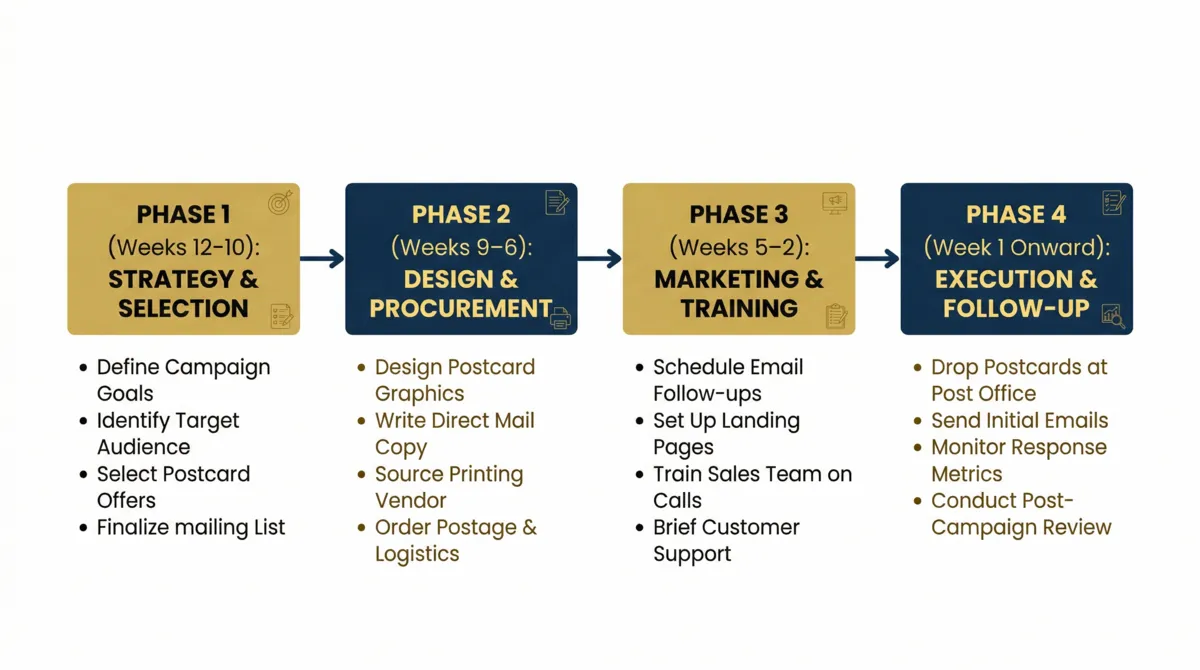
The average corporate exhibitor spends roughly 31.6% of its total marketing budget on trade shows. Protecting that investment starts with a 12-week runway — the minimum viable timeline for a first-time small business exhibitor. Less than that, and rush fees appear at every stage.
Weeks 12–10: Strategic Foundation
This is where most small businesses underinvest. The single most expensive mistake in trade show marketing is exhibiting at the wrong show. Committing capital to an event based purely on total attendance — rather than demographic match — is a near-guaranteed path to negative ROI. Before registering, verify that your ideal buyer's job title and industry are well-represented in the show's historical attendee data. Ask the organizer directly. This information is available in a prospectus or on request.
Once the show is validated, set specific numeric KPIs. Not "generate leads" — but "capture 40 qualified leads to break even at $X cost per lead." Book booth space immediately. Early placement near entrances, main aisles, or anchor exhibitors makes a material difference in foot traffic throughout the event.
Weeks 9–6: Procurement and Creative
All graphic design files must be finalized and submitted to your printer no later than Week 8. Ordering in the final 30 days means paying rush fees that routinely double the print cost. Promotional products require an even longer lead time — custom items often need 6 to 16 weeks from order to delivery. Book travel now. Hotel proximity to the venue is a functional concern: staff walking five minutes to a show floor each morning arrive ready to work. Staff commuting 30 minutes arrive depleted.
Weeks 5–2: Demand Generation and Training
Pre-show outreach is the most neglected phase. Relying on organic foot traffic is not a strategy. Email your existing CRM contacts and scheduled-meeting prospects to lock in booth visits before the show opens. A landing page where prospects book a specific time slot — with an incentive attached — converts at a higher rate than an open invitation.
Staff training must happen by Week 3. Every person manning the booth needs to deliver a 30-second pitch, identify a qualified buyer from a casual browser, and operate the lead capture app without assistance. Role-playing on the actual show floor the day before the event opens is more effective than a conference room rehearsal.
Week 2 to Day Before: Logistics and Verification
Materials ship to the venue's advanced warehouse in Week 2. Photograph everything before it goes in the box — this saves time during post-show dismantle. On the day before the show opens, walk the entire booth space. Confirm all shipped materials arrived, test every display and AV element, and run a team briefing on the floor so staff understand the physical space they're working in.
Budget Planning and Hidden Costs
A first-time small business in a standard 10x10 space should budget between $5,000 and $15,000 all-in. The lower end is achievable with careful planning — lightweight portable displays, early booking, a two-person staff. The upper end reflects a more polished setup with a 3-person team, custom graphics, and a mid-tier show in a major city.
| Cost Category | What's Included | Estimated Range |
|---|---|---|
| Booth Space Rental | 10x10 floor space in primary exhibit hall | $1,000–$3,000 |
| Display Hardware & Graphics | Tension-fabric frame, custom-printed backwall, banners | $1,200–$2,500 |
| Travel & Hotel | Flights, accommodation, per diem for 2–3 staff | $1,100–$3,000 |
| Promotional Products & Print | Giveaway items, brochures, pre-show marketing | $500–$1,800 |
| Shipping & Freight | Round-trip to advanced warehouse and back | $200–$600 |
| Venue Services | Drayage, electrical drops, internet, carpet | $900–$2,500 |
| Total | Full 10x10 first-time exhibitor | $4,900–$13,400 |
The Three Hidden Costs That Blow Budgets
The mandatory fee charged by the venue's exclusive contractor to move your freight from the loading dock to your booth — and back after. Calculated per hundredweight, completely non-negotiable. A 10x10 booth can generate $250–$500 in drayage alone. Shipping in heavy wood crating instead of lightweight tension-fabric displays multiplies this cost. Pack light.
A single standard outlet at your booth costs $150–$800 depending on venue and union rules. Cities like Chicago have strict union regulations prohibiting exhibitors from doing their own electrical connections. Plan electrical as a line item, not an afterthought — and order in advance, because late orders cost 30% more.
Dedicated venue Wi-Fi connections run $200–$1,500, and the signal on a crowded show floor is unreliable even when purchased. Bring a cellular hotspot as your primary connection. Download offline versions of all presentations and lead capture forms the night before.
Missing submission deadlines is the other budget disaster. Failing to file service order forms on time adds penalty fees that commonly inflate your venue invoice by 30% or more. These deadlines are in the exhibitor manual — read it at Week 12, not Week 1.
Booth Setup and Design for a 10x10 Space
A 10x10 booth is 100 square feet. Used well, it can project the presence of a much larger company. Used poorly — cluttered, staffed by people on their phones, fronted by a folding table — it actively repels the traffic you paid to reach.
Three Design Rules That Matter Most
- 1Put key messaging above waist heightAny text or branding in the lower half of your display will be obscured by staff and passing attendees. Company name, tagline, and primary value statement need to be visible from the aisle at eye level or above.
- 2Remove the front-table barrierA table placed squarely at the front of a 10x10 creates a physical and psychological wall. Move it to the side or back. An open perimeter invites attendees to step in — a closed one makes them feel like they need permission.
- 3Create a focal point that earns dwell timeStatic displays get bypassed. A monitor looping a product demo, a touchscreen assessment, or a simple gamification element gives people a reason to stop for 30 seconds — long enough for staff to start a real conversation.
Portable Display Options Under $2,000
Tension-fabric displays have become the practical standard for small business exhibitors. A lightweight aluminum frame with a custom-printed zip-on fabric graphic is fast to assemble without tools and generates a fraction of the drayage cost of wood construction.
| Vendor | Price Range | Best For |
|---|---|---|
| Displays2go | $597–$1,750 | Budget-conscious first-timers — bundled kits with frame, counter, and LED lighting |
| Affordable Displays | $677–$1,500 | Lightweight "Eclipse" and "Lunar" fabric systems — minimal drayage cost |
| American Image Displays | Under $2,000 entry | Scalable — start simple, upgrade to larger island as budget grows |
| Skyline | Higher entry tier | Durability and longevity — best for businesses doing multiple shows per year |
| Nimlok / PosterGarden | $1,500–$3,000+ | Custom-look modular and backlit configurations |
Lead Capture Technology
Paper business cards and fishbowl drops are not a lead capture strategy — they're a guaranteed path to lost data, illegible handwriting, and zero follow-up context. At a show where you've paid $100+ per qualified lead just to be in the room, losing that data on the trip home is an expensive failure.
Modern lead capture apps scan badges (QR or RFID), digitize business cards via OCR, allow real-time conversation notes, work offline when venue Wi-Fi fails, and push contacts directly to your CRM. The moment a badge is scanned, your off-site marketing team can begin an automated nurture sequence while staff is still on the floor.
Segment Leads at the Booth — Not the Hotel
The most important habit to build in every staff member: annotate each lead immediately after the conversation. A "hot" tag on a lead scanned at 2pm is worth far more than trying to reconstruct context from a badge number at 9pm. Segment into three buckets before any follow-up sequence starts:
- Hot: Named a specific pain point, asked for pricing, requested a demo, or defined a buying timeline
- Warm: Meaningful conversation, genuine interest, no immediate urgency or defined budget
- Cold: Brief badge scan, no real conversation, primarily interested in the giveaway
| Platform | Pricing | Best For |
|---|---|---|
| Blinq | ~$4.99/user/month (free trial) | Best overall SMB option — AI-enriched notes, real-time CRM sync, 95%+ data accuracy |
| Mobly | Flat annual subscription | Universal scanning, human-verified OCR, strong offline mode |
| BoothIQ | $499/month unlimited | Advanced reporting without IT complexity |
| Whova | ~$1,000/event | Convenient if the show already runs on Whova infrastructure |
| iCapture | ~$8,000/year | Enterprise only — not suited to small business budgets |
Promotional Products: A Tiered Strategy
99% of trade show attendees will go out of their way to get a promotional product. 52% are more likely to enter a booth if a physical giveaway is visible. But mass distribution of cheap plastic items degrades brand perception — attendees throw them away in the hotel room. The better approach is a tiered model that matches item value to the level of engagement required to receive it.
- T3Perimeter Items — Free to AnyoneLow-cost, high-volume items placed visibly at the booth edge: branded pens, lip balm, small tech accessories. These generate baseline brand awareness and draw people into the booth space. No scan required.
- T2Counter Items — Traded for a ScanMid-value items kept behind the counter: insulated tumblers, canvas totes, quality notebooks. Given in exchange for a badge scan, lead form, or active participation in a product demo.
- T1VIP Items — Earned by Qualified ProspectsPremium items reserved for high-intent prospects who commit to a post-show call or sign a letter of intent: branded jackets, high-capacity power banks, premium tech accessories. The friction filters out casual interest.
Post-Show Follow-Up: The 48-Hour Window
Leads contacted within the first 24 hours of a show closing are seven times more likely to convert than those reached later. Most competitors wait until the following week. The exhaustion of a multi-day event is real — but so is the competitive advantage available to whoever moves first.
For a detailed guide on building the email follow-up sequence itself — subject lines, cadence timing, and B2B vs B2C approaches — see our article on following up a direct mail campaign with email marketing. The same widening gap cadence applies directly to trade show leads.
- D1Day 1–2: The Immediate AnchorHot leads: Manual, personalized email referencing the specific problem discussed at the booth. CTA is a direct booking link for the promised demo or call.
Warm & Cold leads: Automated but contextualized thank-you email. CTA is frictionless — useful content, not a sales pitch. - D3Day 3: The Social BridgeLinkedIn connection requests to all qualified leads — a brief, non-sales note referencing the booth. Moves the relationship from the inbox to a passive social feed.
- D5Day 5–7: The Value InjectionAn email that provides genuine utility — an ROI calculator, benchmark report, or case study applicable to the prospect's industry. The goal is positioning as a consultant, not a vendor pushing for a transaction.
- D10Day 10: The Phone CallA brief, targeted call or voicemail to Hot and unresponsive Warm leads. Reference prior emails and the original booth conversation. Cold leads who haven't engaged move into long-term CRM nurture.
Five Mistakes That Kill Trade Show ROI
1. Choosing the Wrong Show
Exhibiting at a high-traffic event with zero demographic overlap is how most negative ROI happens. Total attendee count is a vanity metric. The only number that matters is how many attendees match your buyer persona. Verify this before registering — not after writing the check.
2. Overcrowding the Booth
A 10x10 space filled with too much product, too much furniture, and walls of explanatory text looks like a storage closet. Attendees don't enter. White space is not wasted space — it's invitation space. A clear sightline, an open perimeter, and one strong focal point outperform a cluttered display every time.
3. Staffing With Untrained People
Staff standing at the booth edge with arms crossed, staring at their phones — the "Guard Dog" posture — is immediately visible and immediately off-putting. Sending people without rehearsed pitches means they can't explain the product clearly, can't qualify buyers efficiently, and can't operate the lead capture tool under pressure. Train everyone before the show, not during it.
4. Ignoring the Exhibitor Manual
The manual contains the submission deadlines, union labor rules, and venue monopoly restrictions that first-time exhibitors routinely miss. A missed deadline adds 30% to your venue invoice. Attempting unauthorized electrical work in a union venue triggers mandatory labor charges at premium rates. Read it at Week 12.
5. Delaying Follow-Up
The most expensive mistake of all: executing everything right at the show, then waiting five days to send follow-up emails. Interest generated on the show floor decays within 48 hours. Competitors who follow up the next morning are already ahead of you in the prospect's inbox. Set up follow-up email templates before the show opens — not after it closes.
Frequently Asked Questions
A first-time small business in a standard 10x10 space should budget $5,000 to $15,000 total. Booth space rental runs $1,000–$3,000, display hardware and graphics $1,200–$2,500, travel and hotel for 2–3 staff $1,100–$3,000, promotional products and print $500–$1,800, and shipping $200–$600. The most underestimated cost is drayage — the mandatory venue fee to move freight from the loading dock to your booth — which adds $250–$500 on its own.
12 weeks is the minimum viable window. This allows time to secure good booth placement, order graphics and promotional products without rush fees, book travel at reasonable rates, train staff, and launch pre-show marketing. Industry veterans often begin 6 to 12 months in advance for major shows. The most expensive thing you can do is compress the timeline — every phase has a financial penalty attached to rushing it.
Drayage (material handling) is the mandatory fee to move your freight from the venue's receiving dock to your booth, store empty crates during the show, and return materials afterward. It's calculated per hundredweight and is completely non-negotiable. A 10x10 setup can generate $250–$500 in drayage alone. The primary way to reduce it is shipping in lightweight tension-fabric displays rather than heavy wood construction.
For small businesses, Blinq and Mobly are the most practical choices. Blinq offers usage-based pricing around $4.99/user/month with AI-powered contact enrichment and real-time CRM syncing. Mobly is designed specifically for SMBs with universal badge and card scanning, offline capability, and human-verified OCR accuracy. Both are far more accessible than enterprise platforms like iCapture at $8,000/year.
Within 24 to 48 hours. Leads contacted within the first 24 hours are seven times more likely to convert than those reached later. Hot leads — prospects who asked for a demo or defined a buying timeline — need a personalized email within 24 hours. Warm and Cold leads get an automated but contextualized email within 48 hours. Most competitors wait until the following week, so speed creates a direct, measurable advantage.
Industry data from 2025/2026 reports an average of $20.98 returned per dollar spent, but this spans all business sizes and preparation levels. The baseline conversion rate for trade show leads is around 10% — heavily dependent on follow-up speed and personalization. 59% of attendees make a purchase decision within three months of a show, and it takes an average of 3.5 sales touches to close a trade show lead. Businesses that follow up within 48 hours, segment leads properly, and run a multi-touch sequence consistently outperform that baseline.
Social Media: Before, During, and After
Before: Priming and Scheduling
Start four to six weeks out. Identify and consistently use the show's official event hashtags on every post. Run targeted social ads aimed at registered attendees. Publish short-form behind-the-scenes content on Instagram Stories and LinkedIn — booth setup previews, product teasers, giveaway hints. Send direct LinkedIn messages to targeted prospects with a specific invitation to your booth number at a specific time.
During: Real-Time Content
Designate one person for social coverage — trying to manage booth traffic and social simultaneously produces poor results on both fronts. High-performing formats: POV booth walkthroughs, demo montages, live-tweeted quotes from keynote speakers. Engineer the booth to generate user-created content: a branded photo activation, custom neon sign, or raffle entry tied to posting with the event hashtag turns attendees into your distribution channel at no cost.
After: Recap and Relationship Building
Publish a post-show recap within 48 to 72 hours: highlight reel, attendance milestones, key moments. Embed it in a blog post for SEO value. Then systematically search for and follow the LinkedIn profiles of every qualified lead scanned at the show, commenting on their content before the formal follow-up email arrives. This digital touchpoint reinforces brand recall and warms the inbox outreach that follows.