Matchback Analysis: Proving Offline Marketing ROI Without QR Codes
Most direct mail attribution systems only count people who scanned a QR code or typed a vanity URL. Matchback analysis counts everyone who received a piece and converted through any channel, including those who found you by searching your brand name, walking into your store, or calling your main number. That typically reveals 30-50% more campaign-attributed conversions than UTM-only tracking shows. BB Direct, 2026
Key Findings
- Matchback analysis works independently of whether the recipient used a QR code, vanity URL, or promo code. It requires no action from the customer.
- The process cross-references your original mailing list against all conversions over a 30-90 day attribution window.
- UTM tracking and matchback are complementary. UTM captures direct response; matchback captures the halo effect on all conversion channels.
- Matchback consistently reveals that direct mail's true influence on total conversions is 30-50% higher than click-based attribution shows.
What Matchback Analysis Is
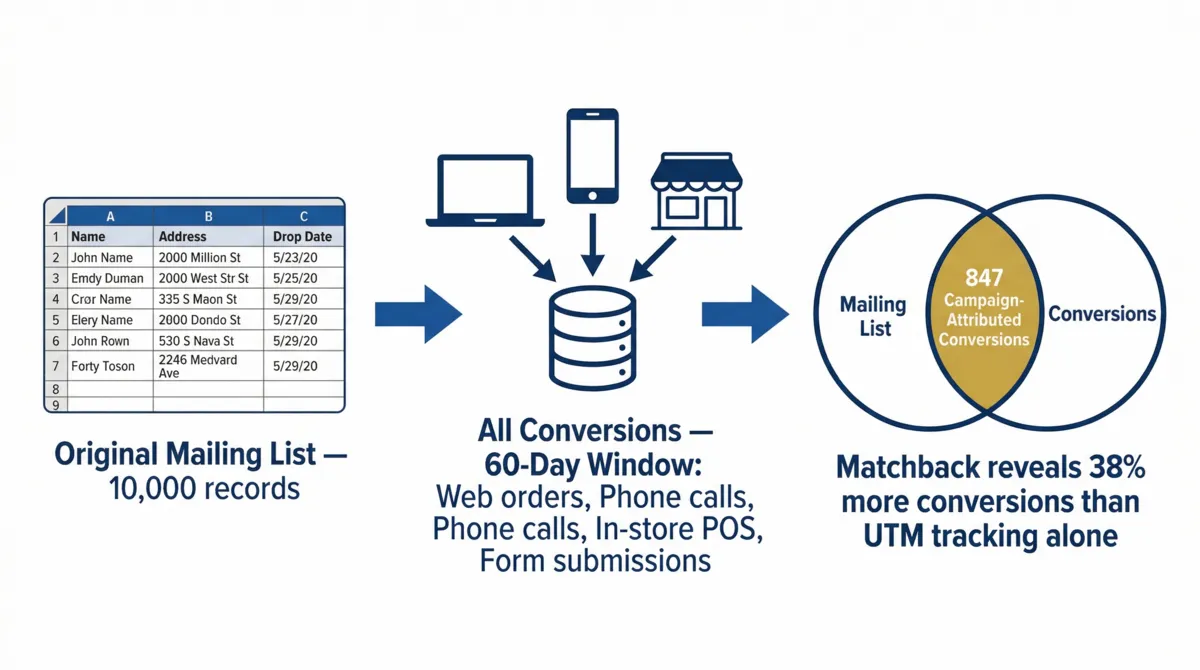
Matchback analysis is an attribution methodology that connects physical marketing activity to real-world conversions without requiring the customer to use a trackable digital element. The core mechanism is simple: you know who you mailed, and you know who bought. Cross-reference the two lists. Anyone who appears on both gets attributed to the campaign.
This approach captures a category of conversion that UTM tracking cannot: the person who received your catalog on Tuesday, thought about it for three days, then searched your brand on Google and made a purchase. GA4 records that session as organic search. The mailer gets zero credit. Without matchback, the catalog appears to have had no impact on that sale.
Matchback is one piece of the full attribution system described in our offline and digital marketing integration guide. That page covers UTM parameters, dynamic QR codes, dedicated landing pages, and matchback together.
How the Matchback Process Works
- 1Preserve the original mailing fileBefore the campaign drops, save a clean export of the mailing list: name, address, email if available, phone if available, and the drop date. This file is the baseline. Do not modify it after the campaign launches.
- 2Collect all conversions over the attribution windowAfter the window closes, export all conversions from every channel: e-commerce orders, CRM closed deals, form submissions, inbound phone call records, and in-store POS transactions. Include name, address, phone, email, conversion date, and conversion value for each record.
- 3Run the matchCross-reference the mailing list against the conversion records. A match occurs when a conversion record shares identifying fields with a mailing list record. Name plus address is the minimum. Adding email or phone increases accuracy. Each matched record is flagged as a campaign-attributed conversion.
- 4Calculate incremental liftCompare the conversion rate of the mailed group against a control group who was not mailed during the same period. The difference in conversion rate multiplied by the total mailed population gives you the incremental conversions attributable to the campaign rather than baseline business activity.
- 5Calculate ROITotal value of matched conversions minus total campaign cost, divided by total campaign cost. Use only the incremental conversions from the lift analysis for the most accurate calculation.
Setting the Attribution Window
| Business Type | Recommended Window | Rationale |
|---|---|---|
| B2C e-commerce | 30 days | Most campaign-influenced purchases happen within 2 weeks of delivery. |
| B2C retail / local service | 30-45 days | Physical store visits and phone calls happen quickly; longer window captures repeat consideration. |
| B2B short sales cycle | 45-60 days | Decision involves more stakeholders; allow time for internal discussion before conversion. |
| B2B long sales cycle | 60-90 days | Enterprise or high-value deals require multiple touches; 90 days captures most campaign-influenced pipeline. |
Start the window from the estimated in-home delivery date, not the mail drop date. First Class mail delivers in 3-5 days; Marketing Mail in 5-10 days. Starting from the drop date understates the window and misses early responders.
Tools That Run Matchback Analysis
Manual Process (Excel or Google Sheets)
For mailing lists under 10,000 records with clean, consistent formatting, matchback can be run manually using VLOOKUP or INDEX/MATCH in Excel. This works for a single campaign but becomes time-consuming at scale.
Direct Mail Platforms With Built-In Matchback
PostcardMania, Lob, and PostGrid all offer matchback reporting as part of their campaign tracking features. These platforms retain your mailing list and run the match automatically against conversion data you provide. They handle the deduplication and partial-match logic that manual processes miss. Find reviewed vendors in our direct mail services directory.
Dedicated Attribution Services
Companies like BB Direct specialize in matchback analysis and cross-channel attribution for direct mail campaigns. They handle large list volumes, multiple match field combinations, and can integrate with your CRM and e-commerce platform. Worth considering for campaigns over 50,000 pieces.
Matchback vs UTM Tracking: What Each Measures
| Attribution Method | What It Captures | What It Misses |
|---|---|---|
| UTM tracking | QR code scans, vanity URL visits, anyone who clicked a trackable link from the physical piece | Direct visits, brand search, phone calls, in-store purchases |
| Matchback analysis | All conversions from mailing list recipients regardless of channel | Conversions from people who were not on the mailing list |
| Combined | Full picture of campaign influence across all channels and conversion paths | Conversions from new customers acquired completely outside the campaign |
Matchback typically identifies 30-50% more campaign-attributed conversions than UTM tracking alone. Counting only UTM-tracked conversions consistently understates offline ROI and leads to budget cuts in channels that are performing well. For the companion guide on trade show attribution, where the same gap between badge scans and actual closed deals exists, see Trade Show Lead Nurture: The 5-Email Sequence That Closes Deals.
FAQ
Matchback analysis proves offline marketing ROI by cross-referencing a physical mailing list against all conversions over a defined time window. Any conversion from someone on the mailing list gets attributed to the campaign regardless of how they converted. It captures the full campaign impact including conversions that arrived through direct website visits, phone calls, and brand search.
30 days for B2C with short purchase cycles. 45-60 days for B2B with moderate sales cycles. 60-90 days for high-value B2B. The window starts on the estimated in-home delivery date, not the mail drop date. Running the window too short misses late-converting customers.
Two files: your original mailing list with name, address, and drop date, and your conversion records for the attribution window with name, address, and conversion date. Adding email or phone to both files increases match accuracy. The mailing list file must be preserved exactly as sent.
Yes. UTM tracking captures people who clicked a trackable link from the physical piece. Matchback captures people who received the piece and converted through any channel — direct visit, phone call, in-store purchase, or organic search — without using a trackable link. Both are needed for complete attribution.
Sources
- BB Direct. Matchback Reporting & Attribution Tools. 2026. bbdirect.com
- Lob. What is cross-channel attribution and how does direct mail fit in? 2026. lob.com