Offline and Digital Marketing Integration for Small Business
Campaigns that combine direct mail with a synchronized digital follow-up produce a 118% lift in response rates compared to direct mail run in isolation. ANA/DMA, 2025-2026 That number does not require a large budget or a marketing team. It requires connecting two things you are probably already doing, just not to each other.
Key Findings
- No practical guide exists covering offline and digital integration for small business across all eight channel types. This is that guide.
- Direct mail open rates run 80-90%. Email open rates run 20-30%. Physical media creates the attention; digital provides the conversion path.
- The biggest reason businesses abandon offline marketing is not that it stopped working. It is that they cannot prove it works.
- The two highest-ROI integrations for small businesses: direct mail with triggered email, and trade show badge scan with automated CRM nurture.
- Matchback analysis reveals direct mail's true influence on conversions is typically 30-50% higher than UTM-only tracking shows.
Why Running Marketing Silos Is Burning Your Budget
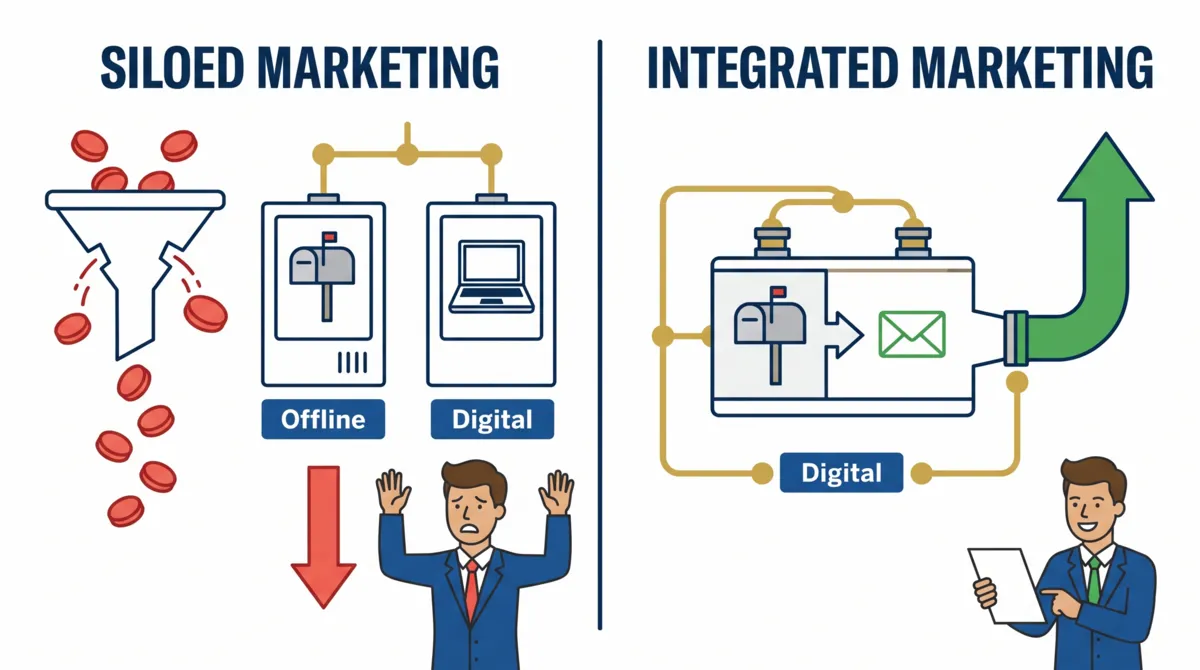
Most small businesses do not run marketing in silos on purpose. It happens because the person managing the email newsletter is not talking to the person who booked the trade show booth. The direct mail budget sits in one spreadsheet and the Google Ads budget sits in another. The campaigns go out. Nobody connects the dots.
The cost of that disconnect is measurable. A B2B software company posted this on r/b2bmarketing: "three trade shows this year, probably $18k all in. Every time we come back with a stack of badge scans and the follow-up sequence goes nowhere. Reply rates are near zero. The contacts are real but they're cold as hell." r/b2bmarketing, 2026 The problem is not the trade show. It is the gap between the physical event and the digital follow-up.
The same pattern plays out in print. A user on r/advertising described printing a front-page newspaper feature three times and seeing zero measurable web traffic. The print piece generated awareness. Without a trackable URL or QR code, that awareness arrived at the website as direct traffic with no source attribution. The marketing manager concluded print does not work. Print worked. The measurement system failed.
Direct mail achieves open rates between 80% and 90%. Email open rates hover between 20% and 30% across most industries. Physical media commands attention in a way digital has not been able to replicate as inboxes became saturated. A well-designed mail piece sits on a desk for days. An email that is not opened in the first two hours rarely gets opened at all.
8 Offline Channels and Their Digital Counterparts
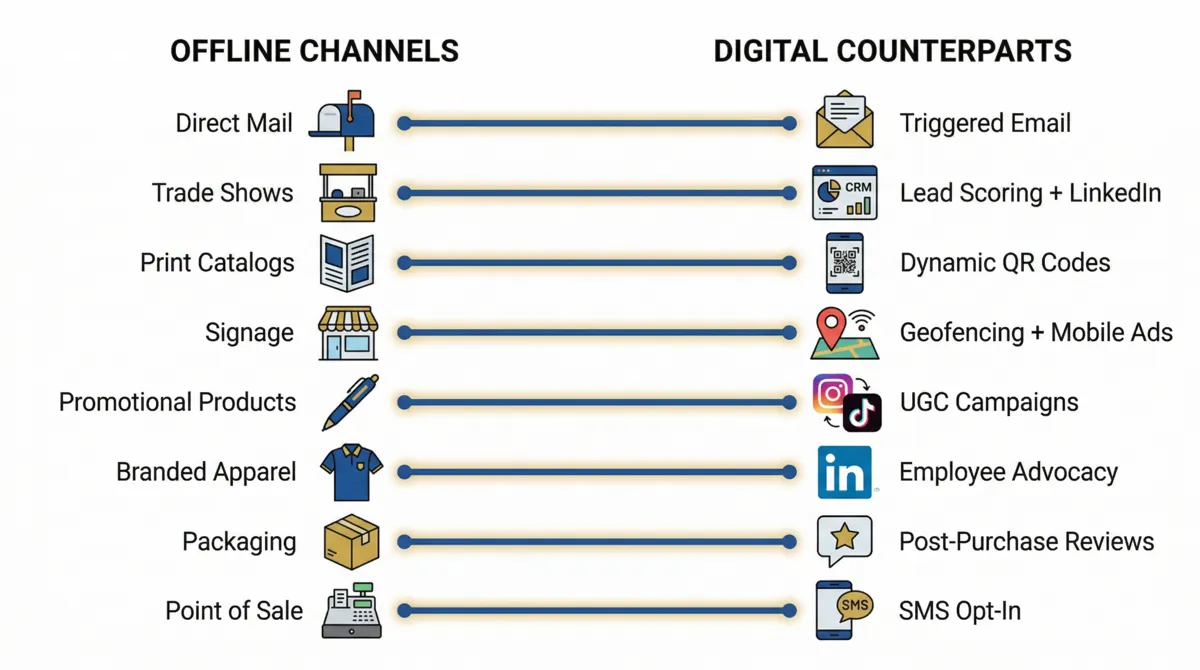
Every physical marketing channel has a natural digital partner. The pairing is based on where the customer is in their decision process when each touchpoint reaches them, and what kind of digital action that physical experience naturally leads to.
Direct Mail + Triggered Email Follow-Up
The average mail piece stays in a household for 17 days and is handled multiple times. The email that arrives 48 hours after the mail piece lands references what the recipient is holding and provides a frictionless digital next step. This is the easiest integration to execute and produces the most consistently documented lift.
Trade Shows + CRM Lead Scoring and LinkedIn Retargeting
A badge scan is not a lead, it is a data point. The moment a badge scans, the contact record should enter your CRM and trigger an automated email sequence. LinkedIn retargeting should launch simultaneously, showing the prospect your brand in their feed while the conversation is still fresh. For the exact email sequence to use, see Trade Show Lead Nurture: The 5-Email Sequence That Closes Deals.
Print Catalogs and Brochures + Dynamic QR Codes to Landing Pages
A printed catalog without a trackable response mechanism is an awareness tool you cannot measure. A dynamic QR code routes the scanner to a UTM-tagged landing page, logs the scan with timestamp and device type, and attributes the session correctly in GA4. For the full retargeting setup, see How to Retarget Print Catalog Readers with Facebook Ads.
Custom Signage + Geofencing and Location-Based Mobile Ads
A sign on a building captures attention from people who are physically nearby. Geofencing extends that attention window digitally — when a prospect enters the defined radius around your location, their mobile device begins serving your ads. For tracking what your signs are actually generating, see QR Code Tracking: Measuring Physical Signage With Analytics.
Promotional Products + Social UGC Campaigns
A branded item that someone actually uses becomes a repeating impression. The digital layer is the UGC strategy: incentivize recipients to post with the item and tag your brand. Find vendors in our promotional products directory.
Branded Apparel + Employee Advocacy
Staff in branded apparel create physical impressions at every client meeting and public appearance. The digital extension is coordinated LinkedIn activity from employees who share company content while visibly associated with the brand.
Packaging + Post-Purchase Email Sequences
A QR code inside the box linking to a review page, a how-to video, or an exclusive repeat-customer offer turns a physical unboxing into a digital engagement event.
Point of Sale Displays + SMS Opt-In
A POS display at the moment of transaction captures a customer who has already decided to buy. That is the ideal moment to capture a phone number for an SMS list. Source vendors in our signage and displays directory.
Where to Start: The Two Highest-ROI Integrations
Running all eight integrations at once is not the right approach for a small team. Pick one focused pairing, execute it properly, and have measurement in place before the campaign launches.
Start Here for B2B: Trade Show Badge Scan + Automated Email Sequence
If you attend trade shows and your follow-up is currently a manual email sent three to five days after the event, this is the integration with the highest immediate impact. Badge scans need to enter your CRM automatically via API. The first email should go out within one hour of the scan, not the next morning. The full sequence is covered in our trade show email follow-up guide.
Start Here for B2C: Direct Mail + Email Follow-Up
For businesses mailing postcards, letters, or catalogs, the integration is a triggered email that goes out 48 to 72 hours after estimated delivery. The email references the specific piece and provides a digital conversion path. This alone generates the 118% response rate lift documented in the ANA/DMA data.
How to Measure the Combined Effect
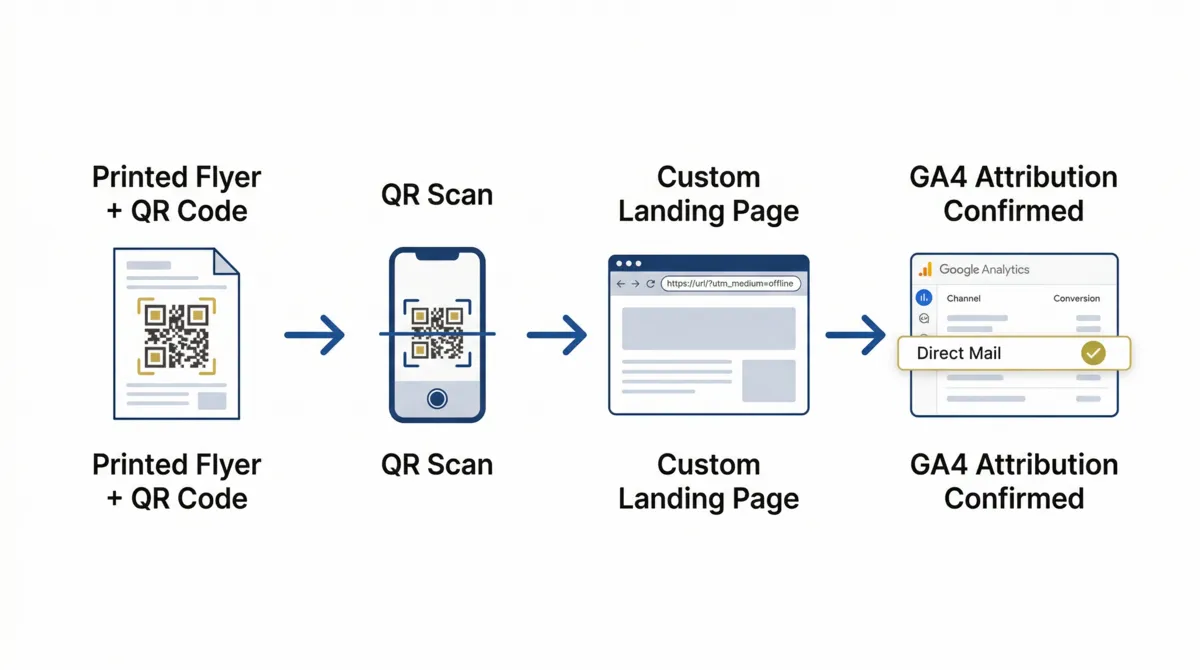
Step 1: UTM Parameters on Every Offline URL
Every URL connected to a physical marketing piece needs UTM parameters. Use utm_medium=offline and utm_source to identify the specific channel: postcard, flyer, catalog, signage. In GA4, create a custom channel group where Medium exactly matches offline. This stops GA4 from placing your physical campaign traffic in the Unassigned bucket.
Step 2: Dynamic QR Codes
Static QR codes bake the destination URL permanently into the printed image. Dynamic QR codes point to a redirect URL that you control: change the destination any time without touching the printed piece. Dynamic codes also capture scan time, location, and device type independently of GA4.
Step 3: Dedicated Landing Pages
Routing offline traffic to your homepage is the most common offline attribution mistake. Every offline campaign needs its own landing page with no navigation, mobile-first layout, and a noindex tag so organic traffic does not contaminate the attribution pool.
Step 4: Matchback Analysis
UTM tracking and QR codes only capture people who interact with the trackable element. Matchback analysis captures everyone who received the piece and converted through any channel — direct website visit, phone call, brand search. For a complete guide to running this process, see Matchback Analysis: Proving Offline Marketing ROI Without QR Codes.
Offline + Digital Budget Allocation Calculator
Real-World Examples
thredUP: Direct Mail A/B Test with Digital Attribution
+128% ROI liftthredUP ran a dormant customer reactivation campaign with two postcard variants tracked via utm_content parameters. Version A used a personalized CEO letter. Version B used a bulleted list. GA4 attribution showed the CEO letter drove measurably higher conversion. Shifting budget to the winning variant increased total campaign ROI by 128%.
Nonprofit: Multi-Channel Donor Synchronization
118% donor liftA nonprofit synchronizing direct mail donation requests with a triggered email follow-up documented a 118% lift in sustained donor contributions compared to mail-only campaigns. The physical letter established emotional connection. The email follow-up arrived while the letter was still on the recipient's desk and provided an immediate digital giving path.
The Vendor Stack: Tools That Connect Offline to Digital
| Tool | What It Does | Connects To |
|---|---|---|
| Lob / PostGrid | Direct mail automation with USPS tracking webhooks | HubSpot, Salesforce, Zapier |
| Blinq / Mobly | Trade show lead capture with real-time CRM sync | HubSpot, Salesforce, Zoho |
| CallRail | Call tracking numbers that push synthetic sessions to GA4 | GA4, HubSpot, Salesforce |
| GA4 (custom setup) | Offline channel grouping, cost import, attribution | Everything via UTM + API |
| QR Tiger / Lob QR | Dynamic QR codes with scan analytics | GA4 via UTM destination URLs |
Find reviewed vendors in our category directories: direct mail services and signage and displays.
Deep Dive Guides in This Series
This page covers the full integration strategy. Each guide below goes deeper on one specific channel pairing or technique.
Frequently Asked Questions
Print a vanity URL on the flyer that redirects to a full UTM-tagged URL. Add a dynamic QR code pointing to the same destination with utm_source=qr. In GA4, create a custom channel group where Medium exactly matches offline. Every visit from that flyer then shows up as a distinct traffic source with conversion data attached.
Multi-channel means being present on multiple channels. Omnichannel means those channels share data and respond to each other. A business where a direct mail delivery triggers an automated email follow-up within 48 hours is omnichannel. The difference is whether the channels talk to each other.
Yes, when connected to digital measurement. Direct mail achieves open rates of 80-90% compared to email open rates of 20-30%. The problem is not that print stopped working. It is that most businesses cannot prove it works because they have no attribution infrastructure. With UTM parameters, dynamic QR codes, and matchback analysis, print becomes as trackable as any digital channel.
Matchback analysis proves offline marketing ROI without requiring the customer to scan a QR code or type a vanity URL. After a campaign closes, export all conversions over a 30-90 day window. Cross-reference those records against your original mailing list by name and address. Any conversion from someone on the list gets attributed to the campaign regardless of how they found you.
Sources
- Amra & Elma. Top 20 Email Marketing Statistics vs Direct Mail Shockers 2026. 2026. amraandelma.com
- Reddit — r/b2bmarketing. Trade show ROI has been basically zero for us three years running. 2026. reddit.com
- Postalytics. Direct Mail Trends & Statistics for 2025. 2025. postalytics.com