Your Offline Campaigns Are Working. You Just Cannot Prove It Yet.
A B2B software company spent $18,000 across three trade shows last year. They came back each time with a stack of badge scans. Reply rates on follow-up emails were near zero. They concluded that trade shows do not work. They were wrong. The shows worked fine. The system for acting on the leads did not exist. r/b2bmarketing, 2026
This is the most expensive mistake in B2B marketing right now. Not the choice of channel. The absence of a system connecting the physical action to a digital outcome.
Today we published the most detailed guide we have written on this topic. Before you read it, here is the short version of why it matters and what most businesses are missing.
The number that should change how you think about your budget
Campaigns that combine direct mail with a triggered email follow-up sent within 48 hours of delivery produce a 118% lift in response rates compared to direct mail run on its own. ANA/DMA, 2025-2026
Not 18%. Not 28%. 118%.
That number is not from a vendor trying to sell you something. It comes from the ANA and DMA response rate reports, which aggregate data across hundreds of campaigns. The lift is real, it is documented, and it is available to any business that is willing to connect two things they are probably already doing separately.
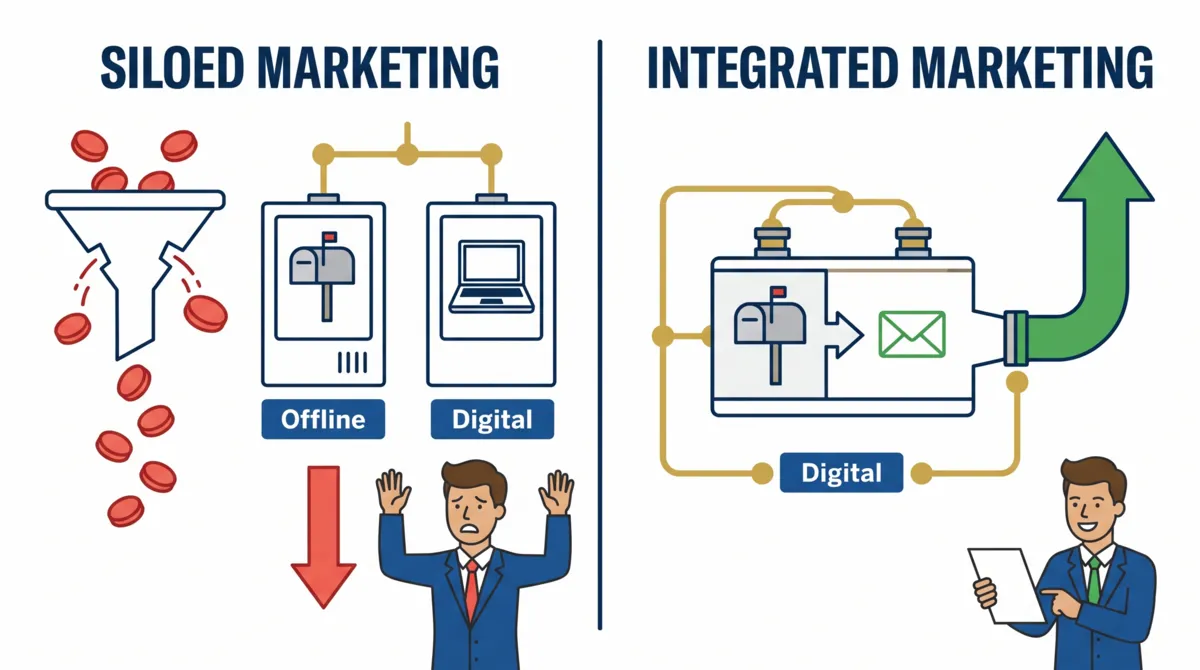
Why the physical world gets abandoned
The pattern plays out the same way across industries. A business runs a direct mail campaign. Responses arrive as direct website traffic with no source attached. GA4 records them as direct visits. The marketing manager looks at the attribution report, sees nothing attributed to the mail campaign, and cuts the budget for next year.
The mail campaign worked. The attribution system did not.
A user on r/advertising described this precisely: they got front-page newspaper coverage three times and saw zero measurable web traffic each time. They blamed print. The real problem was that they had no vanity URL, no QR code, no dedicated landing page. Every person who saw that front page and later searched the brand name showed up in GA4 as organic search. Print received zero credit for traffic it generated. r/advertising, 2024
This is not a small problem. It is why entire categories of marketing that produce real results get cut from budgets every year.
The four things that fix the measurement gap
None of these require a developer. None require enterprise software. They work for businesses with a $5,000 annual mail budget and for businesses with a $500,000 one.
UTM parameters on every offline URL. Every URL you print on a mailer, flyer, catalog, or sign needs utm_medium=offline and a source identifier. In GA4, create a custom channel group where Medium exactly matches "offline." Every physical campaign then shows up as its own traffic source with full conversion data attached.
Dynamic QR codes instead of static ones. Static QR codes lock the destination URL into the printed image. Dynamic codes point to a redirect you control. You can update the destination after printing, and the platform logs every scan with timestamp and device type independently of GA4. That gives you a second data layer that confirms physical engagement even when users do not complete a conversion.
Dedicated landing pages per campaign. Routing offline traffic to your homepage is the most common offline attribution mistake. A dedicated landing page per campaign with no navigation, mobile-first layout, and a noindex tag keeps the attribution clean. When someone from a mail piece arrives on that page, GA4 knows exactly where they came from.
Matchback analysis after each campaign. This is the one most businesses skip, and it is the one that reveals the most. After a campaign closes, export all conversions from every channel over a 30 to 90 day window. Cross-reference names and addresses against your original mailing list. Any conversion from someone on that list gets attributed to the campaign, regardless of how they found you. This process consistently reveals that direct mail's actual influence on total conversions is 30% to 50% higher than UTM-only tracking shows.
A full step-by-step breakdown of all four, with exact GA4 configuration instructions, is in the guide we published today: Offline and Digital Marketing Integration for Small Business.
The two pairings worth starting with
Running eight channel integrations at once is not realistic for a small team. Two pairings produce the highest and most consistently documented results.
For B2B: trade show badge scan plus automated email sequence. The first email needs to go out within one hour of the badge scan. Not the next morning. Not when you get back from the event. One hour. Leads contacted within 24 hours of a trade show interaction are seven times more likely to convert than those reached later. Gushwork, 2026 The $18,000 trade show result described above is almost always a timing problem, not an event quality problem. The leads were real. The follow-up arrived five days late and was generic. By then, the prospect had moved on.
For B2C: direct mail plus triggered email follow-up. The email goes out 48 to 72 hours after estimated in-home delivery. It references the physical piece explicitly. That single addition to an existing mail campaign is where the 118% lift comes from. The full sequence structure, subject line templates, and timing guidance are in our direct mail email follow-up guide.
The broader picture
Direct mail achieves average open rates between 80% and 90%. Postalytics, 2025 Email open rates across most industries sit between 20% and 30%. A physical piece of mail gets picked up and held multiple times over 17 days on average. An email that does not get opened in the first two hours rarely gets opened at all.
Physical media is not competing with digital. It is doing something digital cannot do: commanding sustained, tactile attention from a decision-maker. The job of digital is to provide the frictionless conversion path once that attention exists.
The businesses getting the best results from marketing right now are not running the best digital campaigns or the best physical campaigns in isolation. They are the ones who figured out that a badge scan should trigger an email. That a mail piece delivery should trigger a follow-up. That a QR scan should route to a page that tracks the conversion and feeds the data back into a dashboard alongside everything else.
That is not a technology problem. The tools exist, most of them are inexpensive, and none require a developer. It is a workflow problem. And workflow problems are solvable.
What we published today
The full guide covers all eight offline channel types and their digital counterparts: direct mail, trade shows, print catalogs, signage, promotional products, branded apparel, packaging, and point-of-sale displays. Each pairing comes with specific tools, attribution setup, and the measurement system required to prove what it produces.
The guide includes the Offline and Digital Budget Allocation Calculator, a free interactive tool that takes your total marketing budget, business type, and primary goal and outputs a recommended channel split with specific starting points by segment.
Read the full guide at BizMailNet.com →
What is the single biggest obstacle stopping you from connecting your physical marketing to digital measurement? Is it the tools, the internal workflow, the budget approval process, or something else?
Reply directly to this email. Every response gets read and shapes what we research next.
Sources
- ANA/DMA. Response Rate Report. 2025-2026. amraandelma.com
- Reddit — r/b2bmarketing. Trade show ROI has been basically zero for us three years running. 2026. reddit.com
- Reddit — r/advertising. Print newspaper ads are worthless. 2024. reddit.com
- Postalytics. Direct Mail Trends & Statistics for 2025. 2025. postalytics.com
- Gushwork. Why Trade Show Leads Die After Events. 2026. gushwork.ai