Email Marketing for Seasonal Businesses: Pause Without Penalties
Canceling your email platform in the off-season saves a few hundred dollars. It also wipes your segmentation data, breaks your automation logic, and restarts domain reputation from zero. There is a third option that most seasonal businesses never find in the vendor documentation.
Key Findings
- Canceling an email platform mid-season permanently deletes segmentation, automation history, and engagement data. Data loss is the hidden cost that makes the subscription savings worthless.
- 73% of retail brands see declining margins in winter despite increasing email frequency. More sends in the wrong season damages domain reputation heading into peak season.
- The maximum recommended pause before deliverability degradation begins is three months. Seasonal businesses with longer off-seasons need a structured reactivation plan regardless of platform choice.
- Pay-as-you-go credit models allow true hibernation: no monthly commitment, no data loss, credits available when the active season begins.
- Reactivation emails generate 320% more returns than standard promotional sends. The six-week warm-up sequence before peak season is where the season's performance is determined.
The Hibernation Dilemma for Seasonal Email Senders
Seasonal business owners face the same platform decision every off-season. Keep the subscription running and pay several hundred dollars a month for a platform that will not send a single email until spring. Or cancel the account, lose the segmentation history, and start from scratch when the season opens.
Both options carry costs that are rarely calculated at the time of the decision. Keeping the subscription means paying for idle months. Canceling means rebuilding everything: list segmentation by purchase history, automation flows built over multiple seasons, engagement tagging that identifies the top 20% of subscribers. That work took years to develop. Canceling removes it in an afternoon.
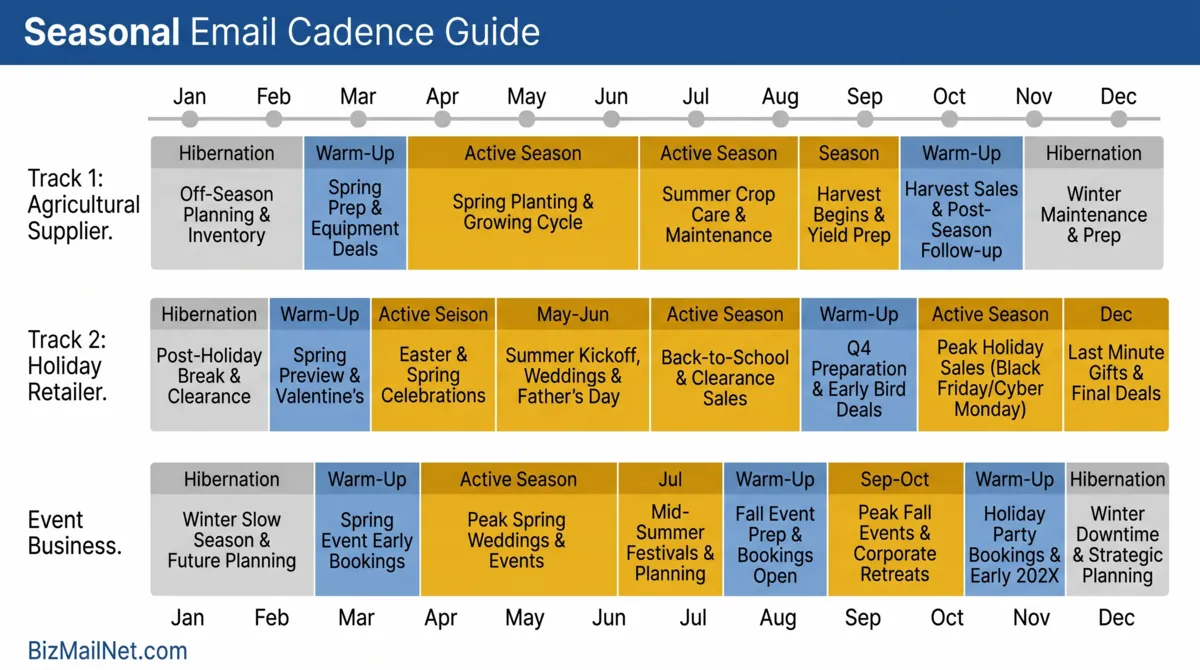
Business types most affected by this pattern include agricultural suppliers whose active season runs from April through October, holiday retailers with a November through January peak and a seven-month quiet period, event businesses whose calendar bunches around summer and fall, and resort or tourism operators whose shoulder seasons are their only viable sending windows.
The third option that most vendor documentation buries: use a platform whose billing model accommodates hibernation without requiring account suspension. Pay-as-you-go credit models charge for sends only. No sends means no charge. The account, the data, and the automations remain intact.
What Happens to Domain Reputation During a Pause
Inbox providers build sending reputation from engagement signals: opens, clicks, replies, and the absence of spam complaints. A domain that goes dark for an extended period loses the positive signal stream that kept it in good standing. The domain does not get penalized for silence, but it loses the accumulated trust that takes months to rebuild.
Spam trap accumulation is the more immediate risk. When an email address is abandoned, it can be converted into a spam trap by inbox providers: an address that exists specifically to identify senders with poor list hygiene. A list that has not been mailed in six months may contain addresses that were valid when last sent and are now spam traps. Sending to them triggers an immediate reputation hit.
"We took three months off and came back in September for our peak season. Everything went straight to spam for the first two weeks. We had to throttle sends down to almost nothing while we rebuilt reputation. Lost the first two weeks of our best selling month." r/marketing, February 2026 (anecdotal)
Jeannine Pine, Senior Director of Agency Services at Oracle Digital Experience Agency, advises a maximum three-month pause before subscriber memory decay becomes a deliverability risk. Beyond that window, subscribers who opted in may no longer remember doing so, causing spam complaints when reactivation begins. The reactivation protocol for seasonal businesses, including the six-week warm-up sequence, is covered in the email deliverability audit guide.
Platform Pause and Snooze Policies
Not all platforms handle hibernation the same way. The differences matter more for seasonal businesses than for any other use case.
Mailchimp
Mailchimp's pause option suspends billing but limits data access during suspension. Campaigns cannot be sent. Automations stop running. Reporting is restricted. When you unpause, the account and data are restored. The pause is available on paid plans only and is not designed for operational hibernation. It is a billing accommodation, not a business continuity tool. For seasonal businesses that need their automation flows to remain live for data capture during the off-season, Mailchimp pause is insufficient.
Brevo
Brevo's send-based pricing creates natural hibernation without account suspension. In months when no campaigns run, no sends occur, and the monthly cost on the free or low-tier plan is zero. Contacts remain intact. Automation flows remain live. Engagement history is preserved. Credits purchased for peak season can be used at any point. This is the closest thing to a native hibernation model in the current market.
Snooze Functionality
Email snooze lets subscribers pause their subscription for a defined period without unsubscribing. They opt out of off-season sends but stay on the list and automatically resume receiving emails when the period ends. Klaviyo and ActiveCampaign both support snooze through subscription preference centers. For seasonal retailers, offering a snooze option during account setup can preserve list size through quiet periods by giving subscribers a middle path between staying subscribed and unsubscribing entirely.
Pay-as-You-Go as the Seasonal Email Solution
Pay-as-you-go credit models eliminate the either/or choice between idle subscription costs and data loss. Credits are purchased in advance and consumed only when campaigns run. In months with no sends, costs are zero. The account stays open, the data stays intact, and the credits roll over to the next active month.
The practical setup for a seasonal business: purchase a credit block sized for the peak season before the active period begins. Use credits only during the active sending window. In the off-season, the platform costs nothing while remaining fully operational for data capture from any offline channels still running.
Off-Season Channel Strategy
The off-season is not a dead period for customer engagement. It is the best time to collect physical mailing addresses and maintain brand presence through channels that carry lower deliverability risk. Direct mail in the off-season keeps the brand in front of customers without triggering the inbox placement problems that come from sending email to a disengaged list. Customers reached by direct mail over the winter are warmer when the email reactivation sequence begins in the spring.
Reactivation Protocol: Six Weeks Before Peak Season
Reactivation emails generate 320% more returns than standard promotional sends, according to Invesp's 2025 analysis. That lift only materializes when the warm-up sequence is executed correctly. Sending the full list on day one of the season eliminates the advantage by triggering spam filters before the domain has rebuilt its reputation with engaged recipients.
The Six-Week Sequence
Weeks 1 and 2: Send only to subscribers who opened or clicked during the most recent active season. This is your highest-engagement segment. High open rates from this group send positive signals to inbox algorithms before any riskier segments receive mail. Keep volume at 20% of your normal peak send rate.
Weeks 3 and 4: Expand to subscribers who engaged at any point in the past 18 months. This group is less predictably responsive but should still produce above-average open rates. Increase volume to 50% of peak send rate. Monitor Google Postmaster domain reputation daily. If reputation drops, slow the ramp.
Weeks 5 and 6: Send to the full active list with hard suppression of anyone who has not opened any of the previous warm-up messages. By week five, the domain has rebuilt sufficient reputation to absorb the volume spike of a full-list send without triggering spam folder placement at major providers.
Before any reactivation send, run a list verification pass. Addresses that were valid at the end of last season may have decayed or been converted to spam traps. Removing them before the warm-up begins protects the domain reputation being rebuilt during weeks one and two.
Seasonal Planning Grid
Select your business type and off-season length to get a recommended platform model and reactivation start date.
FAQ: Email Marketing for Seasonal Businesses
Mailchimp offers a pause option that suspends billing but limits access to your account data during the suspension period. You cannot send campaigns, access full reporting, or edit automations while paused. When you unpause, your data is restored. The pause is only available on certain plan levels, and your automations do not continue running during the pause. For seasonal businesses that need data access or automation continuity in the off-season, a send-based platform with no monthly commitment is a more practical structure.
The generally accepted maximum is three months. Beyond that, domain reputation begins to decay as inbox algorithms deprioritize domains that have gone dark. Spam trap accumulation also increases in lists that have not been mailed, as previously valid addresses may be converted to spam traps over time. If your off-season exceeds three months, use the period to run a list verification pass and plan a six-week warm-up sequence before the first send of the active season.
Email snooze allows subscribers to pause their subscription for a defined period without fully unsubscribing. They opt out of sends during the off-season but remain on the list and automatically resume receiving emails when the snooze period ends. This preserves list size and engagement history while respecting subscriber preference. Klaviyo and ActiveCampaign both support snooze functionality through subscription preference centers. It is particularly valuable for seasonal retailers whose subscribers know in advance they are not interested in off-season communications.
Start the warm-up sequence six weeks before the season opens. Weeks one and two: send only to subscribers who opened or clicked in the last active season. Weeks three and four: expand to subscribers who engaged at any point in the past 18 months. Weeks five and six: send to the full active list with suppression of anyone who has not opened any of the warm-up messages. This approach rebuilds domain reputation incrementally and identifies deliverability problems before the highest-volume campaign days arrive.
For businesses with off-seasons of three months or longer, pay-as-you-go credit models are almost always cheaper than monthly subscriptions. A business with a five-month active season paying $100 per month on a contact-based plan spends $1,200 per year regardless of when it sends. The same business buying pay-as-you-go credits for five active months at equivalent volume might spend $200 to $400 total, depending on list size and platform. The structural advantage of paying only for active months makes the math straightforward at most usage levels.
Sources
- Smaily. Original Ideas to Reset Your 2026 Email Marketing Strategy Before Spring. 2026. smaily.com (vendor source)
- Validity. Email Marketing Benchmarks. 2025. validity.com
- NRF. Holiday Shopping Press Releases. 2025. nrf.com
- Invesp. Re-Engagement Emails Statistics. 2025. invesp.com
- Jeannine Pine, Oracle Digital Experience Agency. Cited in vendor and industry advisory materials. 2025.
- Reddit. r/marketing. Seasonal sending and spam folder. 2026. reddit.com (anecdotal)