B2B Email Marketing Software: The Definitive 2026 Vendor Selection Guide
Most email marketing software comparisons for 2026 rank platforms by feature count. This guide ranks them by what they cost when your list grows, whether their deliverability infrastructure holds under B2B sending conditions, and whether they can connect to the physical channels that still outperform email on response rates. Eight platforms. Independent analysis. No paid placements.
Key Findings
- The 50,000-contact threshold is where contact-based pricing models fracture for SMBs. Mailchimp charges $385 per month at that list size. Brevo's send-based model handles the same list starting at $29 per month.
- 17% of B2B cold emails never reach the primary inbox. SPF, DKIM, and DMARC are now hard gates enforced by Google and Yahoo, not optional configurations.
- Direct mail achieves a 4.4% average response rate versus 0.12% for email alone. Platforms with open API access can connect email follow-up to physical mail triggers, lifting combined response by 27%.
- Automated emails represent 2% of total sends but generate 37% of all email-driven sales. Platform selection should optimize for automation depth, not raw contact capacity.
- Multi-rep B2B teams need upsert-on-email deduplication logic configured before any CRM integration goes live. Without it, database corruption begins within days.
The 50K Contact Breaking Point in Email Marketing Software
Marketing directors running contact-based email platforms report a consistent pattern: growth is the trigger for cost problems. A lead generation campaign pushes the database a few hundred contacts past an arbitrary tier limit. The platform upgrades the subscription automatically. Those new contacts may not have opened an email yet. The invoice reflects the new tier regardless.
The 50,000-contact mark is where the math turns decisively against legacy contact-based models. At that list size, Mailchimp charges $385 per month. Brevo's send-based model handles the same list starting at $29 per month. The difference is not features. It is pricing architecture. Contact-based platforms charge for the size of the database. Send-based platforms charge for server utilization: the volume of emails actually dispatched.
For B2B businesses with long sales cycles, natural list decay compounds the problem. Contacts who are no longer active accumulate in the database. The platform keeps billing for them. The business is paying a premium to store contacts it cannot legally email.
"The CRM integration factor is underrated in this comparison. Most email platforms struggle when you need bidirectional sync with HubSpot or Salesforce at scale. ActiveCampaign handles this better for B2B workflows due to stronger native integrations. Mailchimp fails here completely." r/MarketingAutomation, April 2026
The platform decision in 2026 is not which tool has the best template library. It is which pricing architecture matches how the business actually uses email and whether the platform can connect to the physical channels that remain more effective at driving first response.
Platform Economics: What B2B Email Marketing Software Actually Costs
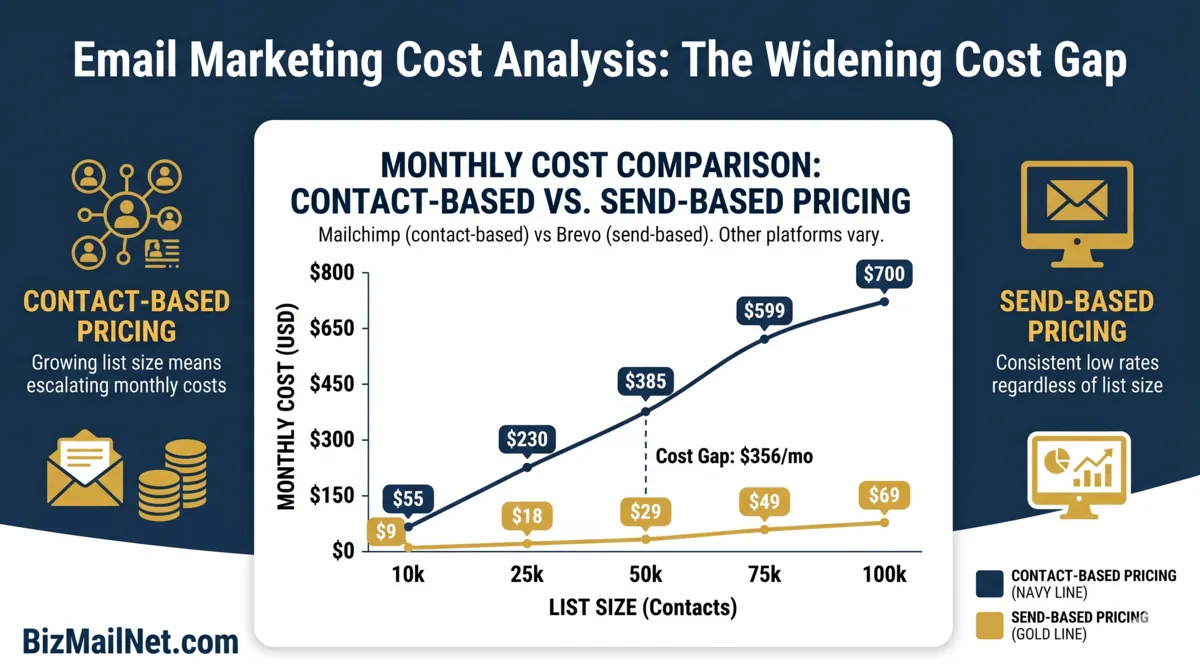
Two pricing philosophies now govern the email marketing software market. Legacy contact-based models (Mailchimp, Constant Contact, Klaviyo, ActiveCampaign) charge monthly fees that scale with the number of stored contacts. Send-based models (Brevo, Mailjet) charge for email volume and store contacts at no additional cost.
The practical difference becomes clear above 10,000 contacts. EmailToolTester's 2026 pricing analysis found that MailerLite is highly competitive under that threshold but becomes one of the more expensive options once a list crosses it, reaching $73 per month for lists approaching 25,000 contacts. Brevo's send-based model keeps costs flat regardless of how large the stored contact base grows.
The Hidden Fee Layer
Beyond the base subscription, contact-based platforms carry a second cost layer that rarely appears in the comparison tables: feature-tier traps. Advanced automation, behavioral segmentation, and A/B testing are frequently locked behind higher tiers. A business on a Starter plan may have a contact count that qualifies for a lower tier but feature requirements that force an upgrade regardless of list size.
HubSpot's Professional tier entry cost sits at $890 per month. That tier unlocks deal attribution, advanced reporting, and custom objects. A five-person B2B team with a 20,000-contact list will rarely use that feature depth at full capacity. The pricing is designed for enterprise organizations that have staff to manage it.
For the cost breakdown by list size and send frequency, the pay-as-you-go vs contact-based pricing comparison maps exactly when each model becomes more expensive for specific sending patterns.
Pricing Model Summary
| Platform | Pricing Model | Cost at 10K Contacts | Cost at 50K Contacts | Unlimited Contacts |
|---|---|---|---|---|
| Brevo | Send-based | $9/mo | $29/mo | Yes |
| Mailchimp | Contact-based | $45/mo | $385/mo | No |
| ActiveCampaign | Contact-based | $149/mo | ~$369/mo | No |
| Klaviyo | Contact-based | $150/mo | ~$400/mo | No |
| HubSpot | Contact-based | $15/mo (Starter) | $890/mo (Pro) | No |
| Omnisend | Contact-based | $16/mo | ~$180/mo | No |
Prices reflect 2026 published rates. Contact counts and tier thresholds vary by platform. Verify current pricing before purchase.
Deliverability Foundations Every B2B Sender Must Have in 2026
Open rate drops from 35% to 8% in a single week are rarely caused by bad subject lines. The more common cause is a domain flagged by Google Postmaster for missing DMARC enforcement, a spike in hard bounces, or a sudden complaint rate increase from a segment that should have been suppressed.
In 2026, Google and Yahoo treat SPF, DKIM, and DMARC as hard gates for bulk senders. A domain without all three configured correctly faces inbox placement failures before the first message is evaluated for content. Domains with all three in place are 2.7 times more likely to reach the primary inbox according to SQ Magazine's 2025 B2B benchmarks.
The Subdomain Separation Requirement
Marketing and transactional emails should never share a domain. A single complaint spike from a marketing campaign can contaminate the domain reputation used for order confirmations, receipts, and password resets. Separate subdomains isolate the risk: mail.company.com for marketing and tx.company.com for transactional.
Deliverability also matters for offline integration. When a direct mail piece goes out and an automated email follow-up arrives three days later, that follow-up is only effective if it reaches the inbox. A domain with reputation problems breaks the attribution loop and erases the lift that the physical mail created.
The full technical audit process, including DMARC record verification, third-party seed list testing, and IP warming protocols, is covered in the email deliverability audit guide for B2B senders.
Integration Ecosystem: CRM Sync, API Access, and Offline Channel Connection
A RevOps manager connects a new email tool to HubSpot. Within five days, sales reps are calling companies that are already active clients. The integration created 4,000 duplicate contacts because it had no upsert logic. No instruction to check whether an email address already existed in the CRM before creating a new record. Two weeks of manual cleanup followed. This is not a rare edge case. It is the default outcome when an integration is deployed without deduplication logic configured first.
Three Integration Tiers
Native bidirectional sync is the strongest option. HubSpot's native email integration captures every email sent by any rep in the background. The sales team stays in Gmail or Outlook; the CRM logs everything automatically. No manual data entry. No missed activity. Zero-touch logging by design.
Middleware connectors (Zapier, Make) are faster to set up but more fragile under load. API rate limit errors create data gaps. A workflow that misses ten syncs in a day because of rate throttling produces exactly the kind of silent database corruption that takes weeks to find.
Custom API connections require developer resources but give full control over deduplication logic, field mapping, and routing rules. For high-volume multi-rep environments, this is the only tier that handles edge cases reliably.
The upsert-on-email standard forces the CRM to query whether an email address already exists before creating a new record. It prevents duplicate contacts regardless of which integration tier is used. Configure it before the integration goes live, not after the database is corrupted.
Connecting Email to Physical Channels
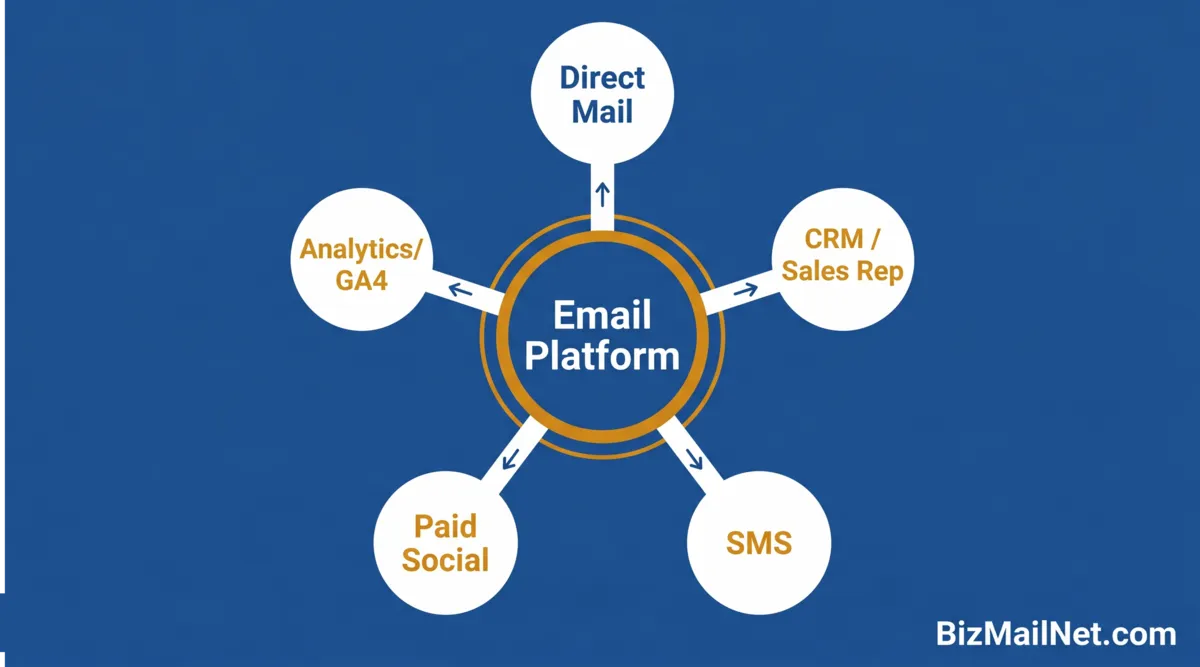
Direct mail achieves a 4.4% average response rate. Email alone achieves 0.12%. Those channels are not competitors. Email is the follow-up layer that makes direct mail measurable. Platforms with open API access can receive a webhook from a direct mail service when a piece is marked delivered, then trigger an email follow-up automatically. The combined response rate lift from this pairing is 27% according to ANA/DMA research.
For the step-by-step setup on deduplication logic and CRM-specific workflows for HubSpot, ActiveCampaign, and Zoho, see the CRM and email integration guide for B2B sales teams.
Seasonal Business Accommodations: Pause Without Losing Your Data
Owners of seasonal operations face a recurring software problem. In the off-season, the email platform costs several hundred dollars a month for a list that will not be mailed until spring. Canceling the account saves that cost but deletes years of customer segmentation data, automation logic, and engagement history. The data loss is permanent. Rebuilding it takes an entire active season.
The structural fix is platform selection. Send-based and pay-as-you-go credit models accommodate seasonal hibernation without requiring account suspension. A business buys send credits before the peak season, uses them during the active period, and pays nothing during the off-months. The database, automation flows, and engagement history stay intact.
Mailchimp's account pause option limits data access during suspension. It is not designed for true operational hibernation. Brevo's credit model is structurally better for seasonal operations because it carries no monthly commitment when sends stop.
Reactivation after a pause carries its own risk. Jeannine Pine, Senior Director of Agency Services at Oracle Digital Experience Agency, advises a maximum three-month pause: longer pauses increase the chance that subscribers forget they opted in and mark reactivation emails as spam. The warm-up protocol before reactivation, starting with the most engaged segment only and expanding over six weeks, is covered in detail in the seasonal email marketing billing guide.
SMB vs Enterprise Feature Comparison for Email Marketing Software
Enterprise platforms are not better platforms for SMBs. They are platforms designed for teams large enough to use the full feature set. The "all-in-one" argument breaks down when 80% of those features go unused and the pricing reflects access to all of them. A single platform handling CRM, email, ads, and reporting is only more efficient when someone on the team is actually using each layer.
| Feature Category | SMB-Tier Needs | Enterprise-Tier Adds | SMB Verdict |
|---|---|---|---|
| Automation depth | 5–10 trigger types, visual builder | 135+ triggers, predictive AI routing | SMB tier sufficient for most workflows |
| CRM native sync | Bidirectional contact sync | Deal attribution, pipeline tracking | Enterprise needed for full pipeline visibility |
| Deliverability tools | SPF/DKIM/DMARC, basic reporting | Dedicated IP, advanced seed testing | Shared IPs adequate under 100K sends/month |
| Pricing model | Contact-based or send-based | Custom enterprise contracts | Send-based preferred for SMB list dynamics |
| Seasonal flexibility | Pay-as-you-go credits | Annual contract commitments | Pay-as-you-go wins for seasonal operations |
| API access | Standard REST API | Custom rate limits, dedicated support | Standard API handles most SMB integration needs |
The deciding factor for most SMBs is not feature depth. It is whether the platform's pricing architecture stays predictable as the list grows and whether the automation builder is usable by a team of one or two people without developer support.
List Growth Cost Calculator: 12-Month Projection
Enter your current list size, projected monthly growth rate, and monthly send volume to see what four major platforms will cost over the next 12 months. Contact-based platforms show auto-upgrade trigger points.
Vendor Profiles: Eight Platforms Compared for B2B Email Marketing
These profiles cover the platforms BizMailNet has reviewed for the email marketing category. Scores and assessments are editorially independent. No vendor has paid for placement or score adjustment. Full reviews are linked from the email marketing vendor directory.
HubSpot
Starting price: $15/mo (Starter). Contact-based. Professional tier: $890/mo.
HubSpot's native CRM and email unification is the strongest available for B2B teams that need full pipeline visibility. Breeze AI adds contextual lead scoring. Deal attribution connects email activity to closed pipeline. The limitation is the pricing cliff between Starter and Professional. Most of the features that make HubSpot useful for B2B operations live behind the $890/mo threshold. For teams that need basic email automation without the full CRM depth, the Starter tier is underbuilt relative to competitors at a similar price.
Best suited for: B2B service companies needing full pipeline visibility and are prepared for the Professional tier price.
ActiveCampaign
Starting price: $15/mo. Contact-based.
The visual automation builder with 135+ triggers and predictive sending AI makes ActiveCampaign the strongest option for B2B teams that run multi-step nurture workflows. Native CRM integrations handle bidirectional sync better than most competitors in this price range. API rate limits at high volume can cause sync delays for large databases. Customer data from r/MarketingAutomation in April 2026 confirms this is the most common complaint from power users at scale.
Best suited for: B2B teams prioritizing complex automation and multi-step workflows over list storage economics.
Brevo
Starting price: $9/mo. Send-based.
Unlimited contact storage on the free tier and send-based pricing make Brevo the most cost-efficient option for businesses with large lists and variable send frequency. Cross-channel SMS and WhatsApp messaging are included at higher tiers. Template selection is narrower than Mailchimp's. For businesses that want to grow a large list without per-contact billing penalties, Brevo is structurally the correct choice. Seasonal businesses should use pay-as-you-go credits rather than a monthly plan.
Best suited for: Finance-conscious SMBs, seasonal businesses, and B2B teams with large databases and low monthly send frequency.
Omnisend
Starting price: $16/mo. Contact-based.
Omnisend's Shopify and WooCommerce native sync and pre-built e-commerce automation flows make it the strongest choice for product-based businesses. Omnichannel SMS and push notifications are built in. It is not a full sales CRM. There are no deal pipelines or opportunity management tools. For B2B teams that need CRM-level pipeline tracking alongside email, Omnisend is the wrong category. For e-commerce, Omnisend's documented ROI of $79 for every dollar spent on automated flows is the highest of any platform reviewed.
Best suited for: E-commerce brands needing deep product catalog integration and automated behavioral flows.
Mailchimp
Starting price: $13/mo. Contact-based.
Mailchimp's interface remains the most accessible for new email marketers and small B2C operations. Broad agency familiarity means external contractors can work in the platform without onboarding friction. The CRM integration story is the weakest of any platform in this comparison. The r/MarketingAutomation community has documented its failure at bidirectional HubSpot and Salesforce sync consistently. Above 50,000 contacts, the $385/mo price point is difficult to justify against send-based alternatives with equivalent feature depth.
Best suited for: Simple B2C newsletters and batch-and-blast retail email. Not recommended for multi-rep B2B operations.
Klaviyo
Starting price: $20/mo. Contact-based.
Deep Shopify integration, advanced predictive data, and SMS functionality position Klaviyo as the dominant platform for high-volume e-commerce. Shinola posted 40% year-on-year BFCM growth via automated Klaviyo flows, the most documented case result in the e-commerce email category. Pricing curves become steep above 50,000 contacts, and scaling issues at that threshold are consistently reported by practitioners. For B2B with long sales cycles, Klaviyo's feature set is oriented toward product and catalog data that does not apply.
Best suited for: High-volume e-commerce operations with established Shopify infrastructure.
Zoho CRM
Starting price: $20/mo. Contact-based.
Zoho's omnichannel inbox, highly configurable native ecosystem, and aggressive pricing make it the strongest all-in-one option for SMBs that want CRM and email under one subscription without HubSpot's price structure. The interface density requires setup investment. Advanced flows need configuration time that Mailchimp or ActiveCampaign do not. For teams comfortable with that setup cost, Zoho reduces the number of third-party integrations needed and the associated data sync risks.
Best suited for: SMBs wanting an affordable all-in-one suite and willing to invest setup time.
Constant Contact
Starting price: $12/mo. Contact-based.
Constant Contact's event organization tools, superior baseline deliverability, and high ease-of-use make it the strongest option for non-profits and event-based businesses. Template flexibility is limited compared to competitors. Pricing becomes relatively expensive at higher contact counts. The platform is not built for multi-rep B2B automation. Where it excels is maintaining high open rates for low-technical-skill user bases with straightforward sending needs.
Best suited for: Non-profits, associations, and event-based small businesses with simple sending requirements.
FAQ: B2B Email Marketing Software Comparison 2026
Contact-based pricing charges a monthly fee based on how many contacts are stored in the platform, regardless of how many emails are sent or whether those contacts are legally emailable. Send-based pricing charges only for the volume of emails dispatched, allowing unlimited contact storage. For businesses with large lists that contain unsubscribed or inactive contacts, send-based pricing reduces software costs considerably. The 23% average annual list decay rate for B2B databases makes this distinction especially important: contact-based platforms keep billing for contacts that can no longer be emailed.
Mailchimp's contact-based pricing reaches $385 per month at 50,000 contacts. Brevo's send-based model handles the same list size starting at $29 per month. The gap widens as list size grows. For B2B businesses with long sales cycles and natural list decay, the contact-based model creates a compounding cost problem because unsubscribed contacts remain billable. Most SMBs find the contact-based model workable under 10,000 contacts. Above that threshold, the send-based model becomes progressively more cost-efficient for typical B2B sending patterns.
Yes. Platforms with open API access and webhook support can trigger physical direct mail through services like Lob or Sendoso when a contact reaches a specific CRM stage or automation trigger. The combined response rate from direct mail followed by a timed email is 27% higher than either channel alone, according to ANA/DMA research. Direct mail achieves a 4.4% average response rate versus 0.12% for email alone. The integration treats email as the follow-up layer that closes the attribution loop on the physical touch.
DMARC (Domain-based Message Authentication, Reporting, and Conformance) is a DNS record that instructs receiving mail servers how to handle emails that fail SPF or DKIM authentication checks. Google and Yahoo treat DMARC as a hard gate for bulk senders in 2026. A domain set to DMARC policy "none," the most common configuration failure, reports failures without blocking them and offers no real protection. Domains with DMARC, SPF, and DKIM all correctly configured are 2.7 times more likely to reach the primary inbox.
ActiveCampaign handles multi-rep B2B workflows well due to its native CRM integrations and 135+ automation triggers that support lead routing by rep assignment. HubSpot's native email and CRM unification is the strongest option for teams that want zero-touch activity logging. The CRM captures every email sent from any rep's inbox automatically. Both require upsert-on-email deduplication logic configured before the integration goes live. Without it, multiple reps importing the same contact from different lead sources will create duplicate records within days.
Automated emails represent only 2% of total sends but generate 37% of all email-driven sales, producing an average ROI of $79 for every dollar spent on automated behavioral flows according to Omnisend's 2026 analysis. This means the automation builder depth of a platform matters more than its raw contact capacity or send volume limits. A platform with a limited trigger library will constrain the flows that drive the most sales, regardless of how cost-efficient its pricing model is at scale.
Sources
- ANA / Data & Marketing Association. Response Rate Report. 2025. mailpro.org
- Omnisend. Email Marketing ROI in 2026. 2026. omnisend.com
- KLIQ Interactive / MailerLite. Ultimate B2B Marketing Reports & Benchmarks 2025-2026. 2025. kliqinteractive.com
- EmailToolTester. Free Email Marketing Services Comparison. 2026. emailtooltester.com
- Forrester. The Forrester Wave: Email Marketing Service Providers, Q1 2026. 2026. iterable.com
- G2. Email Marketing Pricing: How to Avoid Overpaying in 2026. 2026. learn.g2.com
- MarketBetter. B2B Email Deliverability Guide: Stop Landing in Spam 2026. 2026. marketbetter.ai
- Prospeo. Email Finder CRM Integration: 2026 Setup Guide. 2026. prospeo.io
- Smaily. Original Ideas to Reset Your 2026 Email Marketing Strategy Before Spring. 2026. smaily.com (Note: vendor source)
- Reddit. r/MarketingAutomation. Best email marketing tools in 2026: honest breakdown. 2026. reddit.com (Note: practitioner forum, anecdotal)