Pay-as-You-Go vs Contact-Based Pricing: Which Email Platform Is Right for You?
You may be paying for 50,000 contacts while legally allowed to email fewer than 30,000 of them. The rest are unsubscribed. The platform charges anyway. This guide maps exactly when each pricing model stops making financial sense and what to do about it.
Key Findings
- Contact-based platforms bill for stored contacts regardless of deliverability status. With 23% average annual list decay, businesses routinely pay for contacts they cannot legally email.
- Mailchimp charges $385 per month at 50,000 contacts. Brevo's send-based model handles the same list starting at $9 per month for typical B2B send volumes. The gap widens with list size.
- Feature-tier traps are the second pricing problem: automation, segmentation, and A/B testing are frequently locked behind upgrade thresholds regardless of contact count.
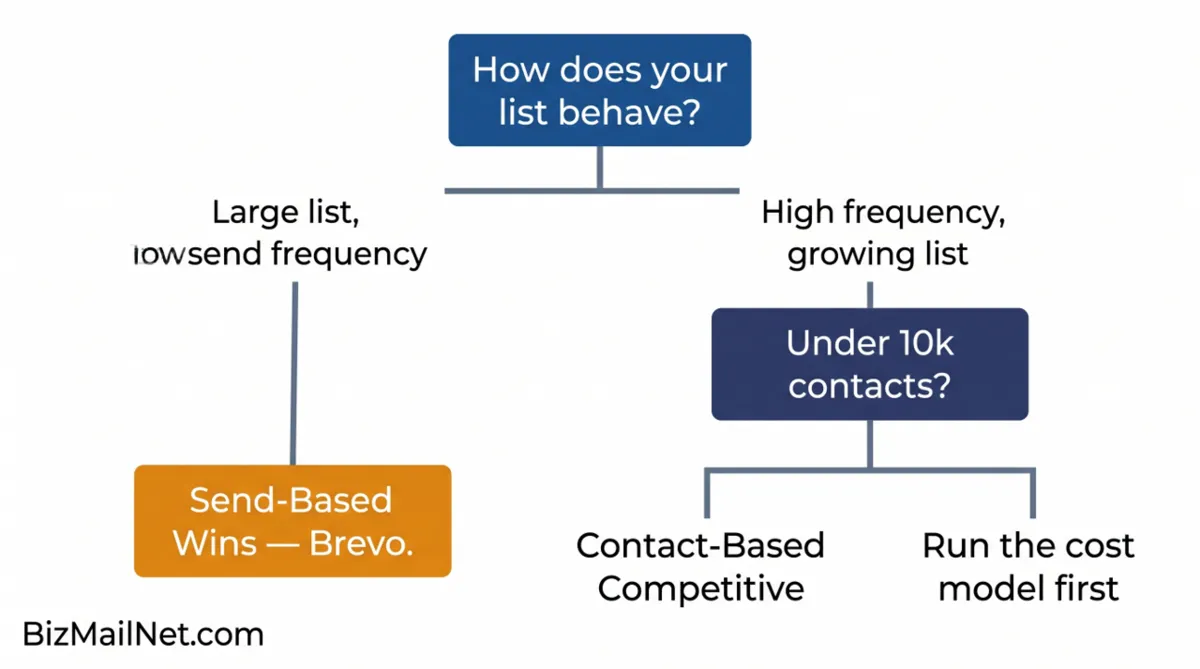
- Send-based pricing favors large lists with infrequent sends. Contact-based pricing favors small lists with very high send frequency, though this advantage narrows above 10,000 contacts.
- API rate limits on contact-based platforms cause CRM sync delays that create duplicate contacts, which in turn inflate the contact count being billed.
How Contact-Based Pricing Punishes List Growth
Contact-based pricing charges a monthly fee based on how many email addresses are stored in the platform. It does not matter whether those contacts have opened an email in two years. It does not matter whether they have unsubscribed. In most cases, the platform keeps billing for all of them until they are manually deleted.
The tier-jump problem compounds this. A lead generation campaign pushes the database a few hundred contacts over a pricing threshold. The platform upgrades the subscription automatically and permanently. Rolling back requires deleting contacts to fall below the threshold, which means destroying data that took months to acquire.
Mailchimp's pricing at 50,000 contacts sits at $385 per month. If 23% of those contacts are unsubscribed or undeliverable, the business is paying $385 to store roughly 11,500 contacts it cannot mail. That portion of the bill is pure overhead.
"We were paying for 60,000 contacts when our active, deliverable list was maybe 35,000. The rest were bounces and unsubscribes that nobody had cleaned. The migration to a send-based platform cut our monthly bill by two thirds." r/coldemail, March 2026 (anecdotal)
The tier-jump trap also applies to features. Mailchimp's Essentials plan includes basic automation. The Standard plan adds behavioral segmentation and send-time optimization. The Premium plan adds advanced segmentation and comparative reporting. A business whose list crosses 50,000 contacts is automatically pushed toward the higher contact tier and may find that the automation features they actually need are on a different feature tier entirely, forcing a second upgrade.
Send-Based and Pay-as-You-Go Models Explained
Send-based pricing charges for the volume of emails dispatched rather than the number of contacts stored. Contacts are held at no additional cost. The monthly fee reflects actual server utilization rather than database size.
Brevo is the clearest example of this model in the B2B market. All paid plans include unlimited contact storage. The monthly fee is determined entirely by how many emails are sent. A business with 80,000 contacts that sends 20,000 emails per month pays the same as a business with 10,000 contacts sending the same volume.
Pay-as-you-go credit models extend this further. Instead of a monthly commitment, credits are purchased in blocks and consumed per email sent. There is no idle cost during months when no campaigns run. This model is the natural fit for seasonal businesses and event-driven senders whose volume is unpredictable month to month. The full seasonal use case is covered in the seasonal email marketing guide.
MailerLite sits between these models. It is highly competitive on contact-based pricing under 10,000 contacts, with a generous free tier. Above 10,000 contacts it becomes one of the more expensive options in its class, reaching $73 per month for lists approaching 25,000 contacts. For businesses expecting rapid list growth, the MailerLite cost curve is worth modeling before committing.
Cost Comparison by List Size and Send Volume
The contact-based model is not always wrong. For small lists with high send frequency, it can be competitive. The crossover point depends on the specific combination of list size, send volume, and growth rate.
When contact-based pricing still makes sense: rapidly growing lists with very high send frequency, where the math of send-based credits would exceed the contact-based tier cost. A business sending 500,000 emails per month to a 40,000-contact list may find that Brevo's higher send tiers approach Mailchimp's contact-based pricing. At that volume, the decision comes down to feature depth and integration quality rather than price alone.
When send-based pricing wins decisively: large lists with long sales cycles sending monthly or quarterly. B2B companies with 50,000 contacts that send one newsletter per month and one campaign per quarter will pay a fraction of the equivalent contact-based tier cost. The more inactive or unsubscribed contacts in the database, the wider the gap in favor of send-based billing.
| List Size | Mailchimp (monthly) | Klaviyo (monthly) | ActiveCampaign (monthly) | Brevo (send-based) |
|---|---|---|---|---|
| 5,000 | $55 | $100 | $79 | $9 |
| 10,000 | $100 | $150 | $149 | $9–$18 |
| 25,000 | $230 | $270 | $249 | $18–$25 |
| 50,000 | $385 | $400 | $369 | $25–$35 |
| 100,000 | $700 | $730 | $599 | $35–$69 |
Brevo costs reflect typical B2B monthly send volumes of 20,000–60,000 emails. Prices are 2026 published rates. Verify current pricing before purchase.
Annual Cost Comparison Table
Enter your list size and monthly send volume to see projected annual costs across four platforms. The table updates to show where pricing tier upgrades occur on contact-based plans.
Which Pricing Model Fits Your Business
Three business profiles map clearly to pricing models. Most B2B businesses fall into the second or third category.
High-Frequency Sender, Growing List
If your list is under 10,000 contacts and you send more than four campaigns per month, contact-based pricing may still be competitive. At low contact counts, the monthly tiers are affordable and the send-based math does not yet produce savings large enough to justify platform migration. MailerLite and ActiveCampaign are defensible choices here. Once the list crosses 15,000 contacts, re-run the cost model.
Large List, Low Send Frequency
B2B companies with long sales cycles, professional services firms, and businesses with large prospect databases that send monthly newsletters or quarterly campaigns are the strongest fit for send-based pricing. A 60,000-contact list sending one campaign per month costs roughly $25 per month on Brevo versus $500+ on Mailchimp. The annual savings covers most of a year's content production budget.
Unpredictable Volume: Seasonal or Event-Driven
Pay-as-you-go credit models eliminate idle monthly costs during quiet periods. No campaign running means no charge. Credits purchased for peak season carry over. This profile maps to any business whose sending volume varies by more than 50% between active and quiet periods. The platform selection guide for seasonal businesses is in the seasonal email marketing billing guide.
FAQ: Email Marketing Pricing Models
Brevo and Mailjet use send-based pricing that charges for email volume rather than contact storage. Brevo allows unlimited contact storage on all paid plans and charges based on monthly send volume, starting at $9 per month for up to 20,000 sends. This model benefits businesses with large lists that send infrequently or carry high proportions of unsubscribed contacts in the database.
Mailchimp offers a pay-as-you-go credit option that allows purchases of email sends in blocks without a monthly subscription. This is considerably more expensive per send than a monthly plan and is designed for very low-volume or infrequent senders. For businesses with lists above 500 contacts sending more than once per month, a monthly plan or a send-based platform like Brevo will cost less.
Most contact-based platforms restrict access to contacts above the lower tier's limit when you downgrade. On Mailchimp, downgrading to a free plan restricts sending to the first 500 contacts and hides the rest from campaign creation. The contacts are not deleted but become inaccessible for sends until you upgrade again. Send-based platforms like Brevo do not restrict contact access on downgrade. Only the send volume limit changes.
Brevo uses send-based pricing. Contacts are stored without a cap on all paid plans. Monthly cost is determined by how many emails you send per month, not how many contacts you have stored. At 50,000 contacts sending 20,000 emails per month, Brevo costs $9 per month. Mailchimp at the same contact count charges $385 per month regardless of send volume.
Start with your current list size and apply a 23% annual decay rate to estimate how many contacts will become undeliverable over 12 months. For contact-based platforms, model your monthly cost at current list size, then at projected list size at months 3, 6, 9, and 12, and check whether any of those sizes cross a pricing tier threshold. Sum the 12 months. For send-based platforms, estimate monthly send volume and multiply by the applicable tier rate for each month. Use the calculator on this page to compare the four main platforms at your specific usage pattern.
Sources
- G2. Email Marketing Pricing: How to Avoid Overpaying in 2026. 2026. learn.g2.com
- EmailToolTester. Free Email Marketing Services Comparison. 2026. emailtooltester.com
- Omnisend. Email Marketing ROI in 2026. 2026. omnisend.com
- Reddit. r/coldemail. Pricing migration discussion. 2026. reddit.com (anecdotal)