Email Segmentation by Behavior: From Shopify Customers to B2B Leads
Behavioral email flows generated 41% of total email channel results from just 5.3% of total sends in 2026. The revenue per recipient for those automated flows runs 18 times higher than for manual broadcast campaigns. Most marketing teams spend the majority of their time on the 94.7% of sends that produce the minority of output. Building behavioral segments feels complicated and broadcasting to the full list feels fast. This guide covers both.
Key Findings
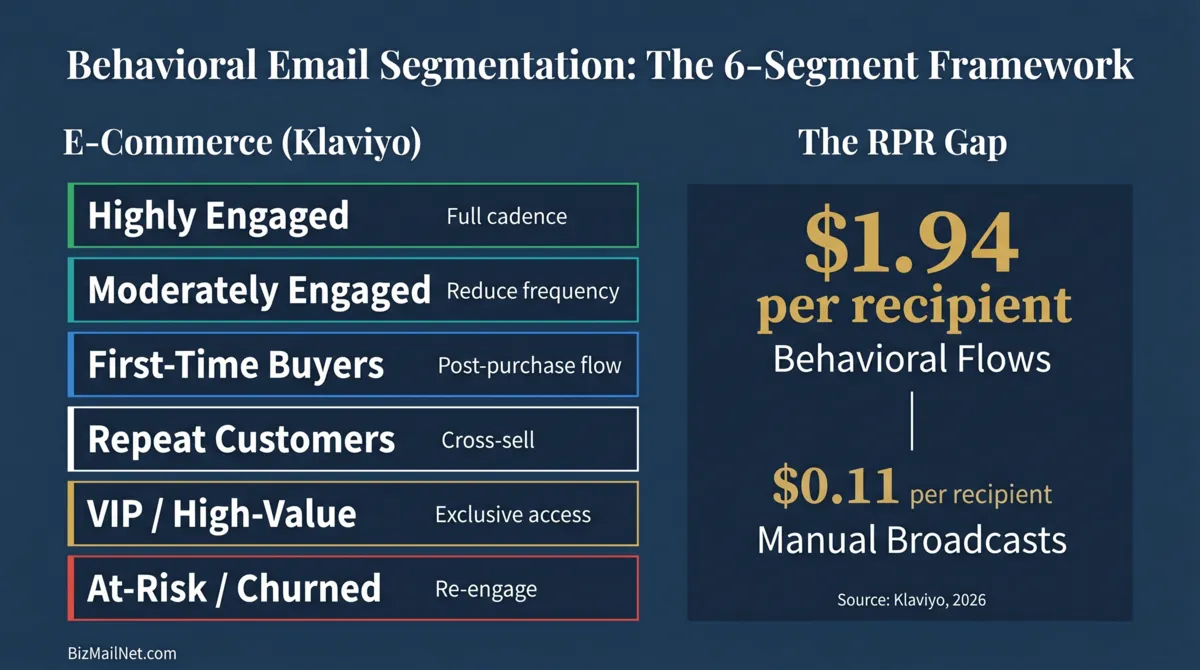
- Automated behavioral flows generated 41% of total email results from 5.3% of sends. Revenue per recipient for flows: $1.94. For manual broadcasts: $0.11. The 18x gap is not a marginal difference. It is a resource allocation problem. (Klaviyo Benchmark Report, 2026)
- The average abandoned cart flow generates $3.65 per recipient, with top performers reaching $28.89. No broadcast campaign matches that figure because no broadcast campaign reaches a contact at the exact moment of high-intent behavior. (Klaviyo Benchmark Report, 2026)
- Flows should generate 60% or more of a Shopify store's total email channel output. If broadcasts are driving more than flows, the automation architecture needs to be rebuilt before the send schedule is optimized. (Klaviyo Structural Health Benchmarks, 2026)
- 20% of total e-commerce sales are driven directly by personalized, segmented email. Personalization here means behavioral context, not a first name in the subject line. (DesignRush, 2025)
Why Demographic Segmentation Fails to Predict Purchases
Demographic segmentation was the dominant approach to email personalization for most of the past decade because it was the easiest data to collect. Job title, industry, company size, and geographic location all appear on signup forms, LinkedIn profiles, and CRM records. They are structured, stable, and simple to filter on.
The problem is that static demographic attributes describe who a contact is, not what they are trying to accomplish right now. Two contacts with identical job titles at companies of the same size in the same industry can have completely different purchase timelines. One is in an active vendor evaluation with a decision expected within 30 days. The other renewed a contract last quarter and will not evaluate again for 18 months. Sending the same campaign to both wastes messaging relevance on at least one of them, and increasing the misalignment between message and recipient intent consistently drives unsubscribes and depresses click rates across the segment.
The same failure mode appears in e-commerce. Two contacts who both purchased from the same product category six months ago are not interchangeable. One has purchased four times since then and is a VIP customer with a high lifetime value. The other made a single purchase, returned it, and has not opened an email in 90 days. Grouping them in the same segment and sending the same promotional campaign produces the wrong message for both: too aggressive for the VIP (who deserves a different experience), and too optimistic for the at-risk contact (who needs a re-engagement sequence, not a new product announcement).
Demographic data still has a role. It informs tone, content format, and the product categories most likely to resonate with a given audience. A solo operator and an enterprise procurement manager should receive different email formats even if they are in the same behavioral segment. But demographic attributes should shape how a message is written, not which contacts receive it or when. That decision belongs to behavioral data.
The Revenue Math: Behavioral Flows vs. Broadcast Campaigns
The core financial argument for behavioral segmentation is not about open rates or click rates. It is about what each send produces per recipient.
The abandoned cart flow is the single highest-performing behavioral automation in e-commerce email. The average revenue per recipient for an abandoned cart flow runs $3.65, with top decile performers reaching $28.89 per recipient. No promotional broadcast campaign approaches those figures because no broadcast campaign intercepts a contact in the specific moment of documented purchasing intent that an abandoned cart event represents.
Klaviyo's 2026 Structural Health Benchmarks set a clear performance standard: email should contribute 25 to 40% of total store output. Flows should generate 60% or more of the email channel's total. If a store's email analytics show that broadcasts are driving more than flows, the automation architecture is incomplete. Adding more campaigns to a broken automation foundation produces diminishing returns on every additional campaign sent.
The resource implication is direct. A marketing team that spends four days per week writing and scheduling broadcast campaigns and one day per week on automation is allocating effort inversely to output. Building the six core behavioral segments and the flows that serve them is a one-time investment that continues producing output 24 hours a day without additional campaign scheduling.
The Six Core Behavioral Segments for E-Commerce
These six segments cover the complete customer lifecycle for a Shopify store. They are the starting architecture before any additional micro-segments are added. Each segment informs a distinct automation or campaign strategy, and each is defined by behavioral criteria rather than static attributes.
Segment 1: Highly Engaged
Definition: Opened or clicked at least one email in the past 30 days.
Strategy: Full broadcast frequency. New product announcements, promotional campaigns, and time-sensitive offers all go to this segment first. Positive engagement signals from this group provide reputational cover for sends to lower-engagement tiers. Klaviyo's AI-powered product recommendations are most effective here because this segment has recent behavioral data to train on.
Segment 2: Moderately Engaged
Definition: Opened or clicked at least one email in the past 31 to 90 days, but not in the past 30.
Strategy: Maintain send cadence but reduce frequency by 20 to 30%. Watch for movement into the Highly Engaged segment after sends. This group is still active but showing early signs of fatigue or declining interest. Do not suppress. Do not apply win-back logic yet. Monitor and continue mailing at a slightly lower rate than the Highly Engaged tier.
Segment 3: First-Time Buyers
Definition: Placed exactly one order. Has not purchased again.
Strategy: The post-purchase flow is the highest-leverage automation for this segment. A well-built post-purchase sequence runs 3 to 4 emails over the first 14 days: a delivery confirmation, a check-in on satisfaction, a product education email, and a curated recommendation for the next purchase based on the first order's category. The goal is a second purchase, which statistically predicts a higher lifetime value than a contact who purchases only once.
Segment 4: Repeat Customers
Definition: Placed two or more orders. Has purchased within the past 90 days.
Strategy: Loyalty reinforcement and category expansion. Repeat customers have demonstrated a preference for the brand. Campaigns to this segment can carry more brand voice and fewer promotional incentives. This group buys without a discount trigger. Cross-sell campaigns introducing adjacent product categories perform well here. Loyalty program invitations, early access to new collections, and referral program offers all convert at higher rates with repeat customers than with any other segment.
Segment 5: High-Value or VIP
Definition: Lifetime spend is two to three times the store's average order value, or the contact ranks in the top 10% of all customers by total spend.
Strategy: This segment receives a qualitatively different experience, not just a higher frequency. Exclusive early access, personalized outreach, and premium physical touchpoints (covered in the offline channels section below) are all appropriate here. VIP contacts should never receive the same email template as the general broadcast list. The moment this segment's experience becomes indistinguishable from a mass campaign, the behavioral signal that defines them loses its operational meaning.
Segment 6: At-Risk or Churned
Definition: No purchase in 90 to 180 days (At-Risk) or no purchase in 180+ days (Churned).
Strategy: At-Risk contacts enter a structured re-engagement sequence immediately upon meeting the threshold. The goal is a single click, on anything, before the contact slides into the Churned tier. Churned contacts have missed the re-engagement window and need a win-back campaign: one high-value email, a direct offer, and a clear decision point before permanent suppression. This segment also feeds the offline trigger: contacts who fail both the re-engagement sequence and the win-back campaign are candidates for a direct mail touchpoint before any permanent archive decision is made.
B2B Intent Scoring: What to Track Beyond Job Title
B2B behavioral segmentation does not operate on purchase events the way e-commerce segmentation does. B2B contacts rarely make a purchase without a lengthy evaluation period, which means behavioral signals must be read differently. The question is not "has this contact bought?" but "is this contact actively evaluating?"
Intent scoring assigns point values to specific behavioral actions and sums them into a score that reflects a contact's current proximity to a purchase decision. The actions that matter most are those that indicate research behavior specific to the purchase stage, not general content consumption.
| Behavioral Signal | Intent Level | Why It Matters |
|---|---|---|
| Pricing page visited 2+ times in 7 days | High | Active cost evaluation. Contact is comparing options. |
| Integration or API docs page visited | High | Technical evaluation in progress. A decision-maker has delegated research. |
| Demo or trial registration | High | Explicit action to experience the product. Highest-converting behavioral trigger. |
| Case study or ROI calculator page viewed | Medium-High | Building an internal business case. Often precedes a demo request. |
| Comparison content downloaded | Medium | Active vendor shortlisting. Contact is aware of alternatives. |
| Blog post or educational content viewed | Low-Medium | Awareness and interest stage. Not yet in active evaluation. |
| Whitepaper download at signup | Low | Initial interest only. No predictive value for purchase timeline without further activity. |
DesignRush's 2025 B2B Outreach Analysis found that segmenting leads by behavioral signals, such as the frequency of site visits, login patterns, feature use, or recent purchase activity, produces better deliverability and engagement outcomes than static demographic grouping. The operational implication is that a B2B contact who visited the pricing page four times and downloaded a comparison guide this week should receive a different email than a contact who has the same job title but has not visited any high-intent pages in six months.
The practical setup for B2B intent scoring in email platforms requires CRM integration or a Customer Data Platform (CDP) layer that pushes website events into contact records. HubSpot, Salesforce Marketing Cloud, and ActiveCampaign all support event-based contact properties that can be used as segment criteria. For teams without a CRM, UTM-tracked landing pages and form completions provide a partial proxy: a contact who clicked a pricing page CTA from an email and completed a contact form is showing stacked behavioral signals that warrant immediate high-intent follow-up.
Building Segments in Klaviyo
Klaviyo's segment builder uses a condition-and-filter logic system. Each segment is defined by one or more conditions that contacts must meet to qualify, and conditions can reference email behavior, purchase events, on-site behavior, and custom properties synced from Shopify or a CRM.
Setting Up the Six Core Segments
Navigate to Audience, then Segments, then Create Segment. Each segment below uses the condition types available in Klaviyo's standard interface as of 2026.
Highly Engaged: Condition: "Properties about someone": "Can receive email marketing" is "true." AND "What someone has done (or not done)": "Opened Email" at least once in the "last 30 days." This segment updates dynamically as contacts open and close the 30-day window.
First-Time Buyers: Condition: "What someone has done (or not done)": "Placed Order" exactly 1 time over "all time." This segment is the primary audience for the post-purchase automation flow. As contacts place a second order, they drop out and move into the Repeat Customers segment automatically.
VIP or High-Value: Condition: "Properties about someone": "Total Value of Orders Placed" is "greater than" your calculated threshold (typically 2 to 3 times your store's average order value). In Klaviyo, this property is synced automatically from Shopify as a predictive analytics field. You can also use Klaviyo's "Predicted CLV" property to build a forward-looking VIP segment rather than one based purely on historical spend.
At-Risk: Condition: "What someone has done (or not done)": "Placed Order" zero times in the "last 90 days." AND "What someone has done (or not done)": "Placed Order" at least 1 time "before 90 days ago." This isolates customers who were active but have gone quiet, excluding contacts who have never purchased.
Connecting Segments to Flows
Once segments are built, each one connects to a flow through a trigger or a segment-membership condition. The abandoned cart flow is triggered by the "Started Checkout" metric event, not by segment membership. It fires when Klaviyo receives the event from Shopify, regardless of which segment the contact belongs to. The At-Risk and Churned segments feed into flows via the "Added to Segment" trigger: when a contact's behavior causes them to enter the At-Risk segment, the flow starts automatically.
An experienced Klaviyo operator on r/Klaviyo summarized the correct 2026 setup priority for new stores: connect Klaviyo to Shopify and sync customers, products, and orders first. Then build the core flows in this order: welcome series, abandoned cart, post-purchase, and win-back. Segment the audience for targeted campaigns only after the flows are running and generating baseline data. Attempting to build complex campaigns before flows are in place means optimizing the low-output activity before the high-output foundation is established.
Building Segments in Mailchimp and Brevo
Not every Shopify store uses Klaviyo. Mailchimp and Brevo both support behavioral segmentation, with meaningful differences in depth and data availability compared to Klaviyo's native Shopify integration.
Mailchimp
Mailchimp's Shopify integration syncs customer order data, which enables purchase-based behavioral segments. The segment builder under Audience, then Segments, then Create Segment supports filtering by "E-Commerce" conditions including: number of orders placed, total amount spent, most recent purchase date, and product category purchased.
To build the First-Time Buyer segment in Mailchimp: select "E-Commerce" as the condition category, then "Number of Orders" equals "1." For VIP contacts: "Total Spent" is "greater than" your threshold amount. For At-Risk: "Date of Last Order" is "more than 90 days ago" and "Number of Orders" is "greater than 0."
The key limitation is browse behavior. Mailchimp does not track on-site browse events (product page views, cart additions) from Shopify with the same granularity as Klaviyo. Abandoned cart and browse abandonment flows are available in Mailchimp, but the triggering data is shallower. Stores that need browse abandonment flows tied to specific product page views, or predictive lifetime value segments, will find Mailchimp's capabilities insufficient and should evaluate Klaviyo as a replacement.
For email engagement-based segments in Mailchimp: navigate to Audience, then Segments, then "Add a segment condition." Select "Campaign Activity" and filter by "Opened" or "Clicked" within a specified campaign or time window. Mailchimp's email engagement segmentation works at the campaign level rather than across all sends over a rolling time window, which is a functional difference from Klaviyo's engagement-based segment logic.
Brevo
Brevo's contact segmentation uses an attribute and event filter system. Behavioral segmentation in Brevo requires either a Shopify plugin integration (available in the Brevo marketplace) or manual event tracking via Brevo's JavaScript API, which pushes custom events from the website into contact records.
Once the Shopify integration is connected, Brevo syncs order history into contact attributes: total orders, total spend, last purchase date, and order tags. Segments are built in Contacts, then Segments, then "Add a new segment," using these synced attributes as filter conditions. The logic structure is similar to Mailchimp: filter by purchase count, spend amount, or last purchase date to approximate the six core segments.
Brevo's pricing model makes it a defensible choice for stores with large contact counts but infrequent sends. Because Brevo charges by email volume rather than contact count, storing large behavioral segments without sending to them frequently does not raise the monthly invoice. Klaviyo and Mailchimp both charge by active profile or contact count, which makes large suppressed segments or low-frequency VIP segments more expensive to maintain on those platforms.
| Capability | Klaviyo | Mailchimp | Brevo |
|---|---|---|---|
| On-site browse behavior tracking | Native, real-time | Limited | Via JavaScript API |
| Abandoned cart flow | Native trigger | Available (shallower data) | Available via automation |
| Predictive lifetime value segmentation | Native (Klaviyo AI) | Not available | Not available |
| Purchase-based segments | Native, granular | Available via Shopify sync | Available via plugin sync |
| Pricing model impact on large segments | Active profile-based billing | Contact count billing | Send volume billing (segments are free to store) |
Full reviews of each platform, including 2026 pricing, automation capabilities, and verified customer sentiment, are in the email marketing vendor directory.
Connecting Digital Segments to Offline Channels
Behavioral segments do not have to stay in the email platform. The same data that defines who belongs in a VIP segment or an At-Risk segment can drive physical marketing decisions with a conversion probability that cold direct mail cannot match.
VIP Segment to Premium Direct Mail
The VIP or High-Value segment is the highest-value audience for offline marketing investment. These contacts have demonstrated purchase behavior across multiple transactions, which means a physical piece of mail lands in front of people with a documented history of buying, not cold prospects being introduced to the brand for the first time.
The workflow: export the VIP segment from Klaviyo or Mailchimp as a CSV. Submit the export to a direct mail vendor that supports physical address appending (Taradel, PostcardMania, and Lob all offer this service). The vendor matches email records against physical address databases and returns a mailable list. Use a unique QR code or vanity URL on the physical piece so that any resulting website visit can be tracked in GA4 as a campaign-attributed event. The physical touchpoint should not repeat the same promotional message as the current email campaign. VIP contacts receive an experience that the general list does not. That exclusivity is itself part of the value signal.
At-Risk and Churned Segments to Re-Engagement Mail
For contacts who have completed a full digital re-engagement sequence without clicking, the digital channel is exhausted. The physical channel remains. Export At-Risk and Churned contacts who have failed the email sequence, append physical addresses, and send a postcard or catalog. The physical piece does not reference the email sequence. It is a fresh touchpoint from a different channel, leading with product value rather than "we've been trying to reach you."
Keep the suppressed digital segment active for 60 days after the physical piece goes out. Any contact who visits the site through the trackable URL during that window is a reactivated contact for attribution purposes. After 60 days with no cross-channel response, archive the record with a documented trail of all attempts made.
Behavioral Segmentation as the Direct Mail Match Key
The full integration of behavioral email segmentation with direct mail attribution requires clean digital records as the foundation. A Klaviyo segment built on accurate purchase history and verified email addresses produces a physical mailing list of people the brand knows, not a rented audience of strangers. That prior relationship is what makes the physical touchpoint more likely to produce a conversion than a cold list of similar demographics would. The list hygiene strategy guide covers how to maintain the data quality that makes this cross-channel integration reliable.
Segmentation Strategy Wizard
Answer three questions about your current setup. The wizard outputs a recommended segment architecture with build priority and platform-specific notes for your stack.
FAQ
Demographic segmentation groups contacts by static attributes: job title, company size, industry, location, or the lead magnet they downloaded at signup. These describe who a person is, not what they intend to buy. Behavioral segmentation groups contacts by actions taken: pages visited, products purchased, cart abandonment events, pricing page views, or email clicks. Behavioral data predicts purchasing intent directly because it measures what a contact is doing right now. A CMO who visited the pricing page three times this week is more likely to purchase than a CMO who downloaded a whitepaper six months ago, regardless of identical demographic profiles.
Start with the six core behavioral segments: Highly Engaged (active within 30 days), Moderately Engaged (active within 90 days), First-Time Buyers, Repeat Customers, High-Value or VIP contacts (spending two to three times the average order value), and At-Risk or Churned contacts (no purchase in 90 to 180 days). Build all six before adding micro-segments. Adding complexity before the foundation is in place produces overlapping segments, misfiring automations, and metrics that cannot be traced to a specific audience definition.
Repeated visits to a pricing or plans page are the strongest single signal of active purchase evaluation. Other high-value signals include integration or API documentation page visits, webinar or demo registrations, trial activation events, case study or ROI calculator page views, and comparison content downloads. The key distinction is specificity: a contact who visits the pricing page three times in one week is demonstrating a time-sensitive intent that a contact who downloaded a whitepaper six months ago is not.
Mailchimp supports behavioral segmentation through purchase activity and email engagement filters. For Shopify stores, its integration syncs order data and allows segmentation by purchase count, purchase date, product category, and average order value. The limitation compared to Klaviyo is that Mailchimp does not track on-site browse behavior, product page views, or cart abandonment events with the same depth. For stores whose primary need is purchase-based segmentation, Mailchimp's filters are sufficient. For browse abandonment, view-based triggers, or predictive lifetime value, Klaviyo is the stronger tool.
Export the VIP segment as a CSV from Klaviyo, including all available contact fields. Upload to a direct mail vendor that supports address appending. The vendor matches your email records against their physical address database and returns a mailable list. Use a unique QR code or vanity URL on the physical piece so that any resulting website visit can be tracked in GA4 as a campaign-attributed conversion. VIP contacts are the highest-value audience for this approach because they already have a documented history of purchasing, making the physical piece more likely to produce a return than a cold direct mail send.
Sources
- Klaviyo. Email Benchmark Report. 2026. klaviyo.com (vendor source)
- DesignRush. Email Marketing Statistics Benchmark Survey. 2025. designrush.com (vendor source)
- Referral Candy. Klaviyo Segmentation Strategies: The Complete Guide to Boosting Ecommerce Revenue in 2026. 2026. referralcandy.com
- Reddit. r/Klaviyo. What is your best Klaviyo tip for 2026? 2026. reddit.com (anecdotal)