Email List Cleaning and Segmentation: The 2026 SMB Playbook
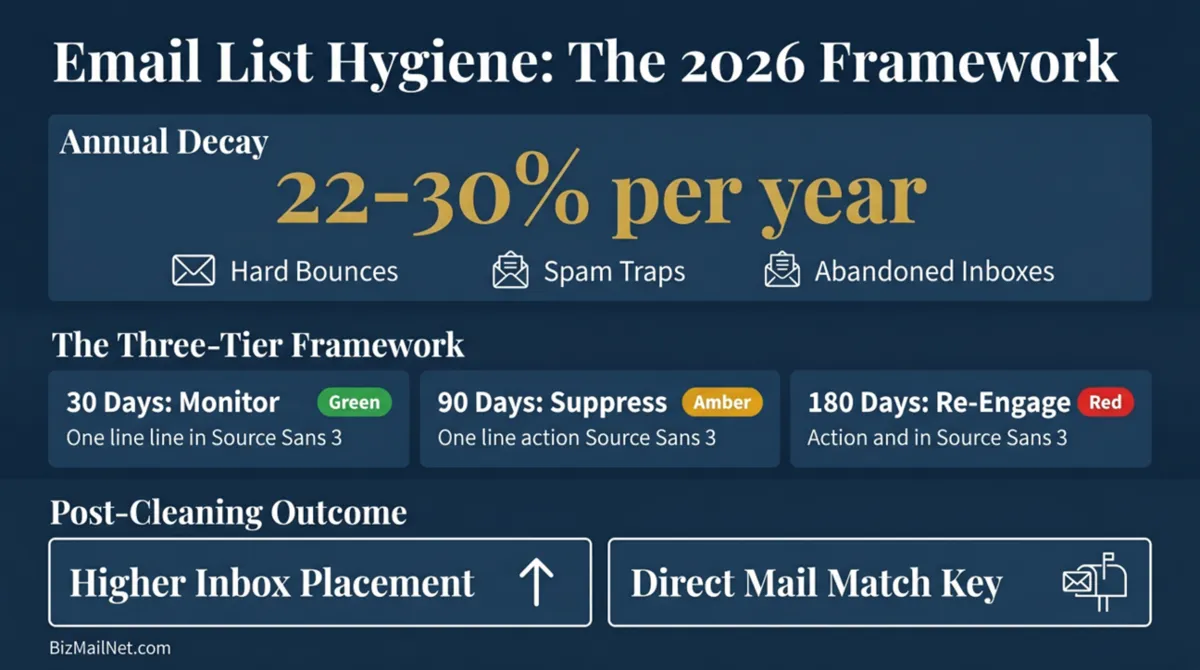
Email databases decay at 22–30% per year. A list of 10,000 contacts built last January now contains somewhere between 2,200 and 3,000 addresses that are invalid, abandoned, or functioning as spam traps. Those dead records do not sit quietly. They generate soft bounces, accumulate complaints, and drag down sender reputation until messages stop reaching the people who actually want them. What follows covers how decay works, the cadence to clean on, when to suppress versus delete, how to segment by behavior, how to structure re-engagement, and how a clean digital list becomes the foundation for direct mail attribution.
Key Findings
- 43% of email professionals report active list decay and invalid address problems in 2026. The list degrades continuously regardless of how recently it was built. (DesignRush, 2026)
- 62% of deliverability failures trace back to spam filtering triggered by unengaged contacts, not technical authentication gaps. (DesignRush, 2026)
- The average B2B buying cycle runs longer than 10 months. Standard 90-day deletion rules remove contacts who are still in an active evaluation phase. (HubSpot, 2026)
- Behavioral email flows generated 41% of total email results from just 5.3% of total sends in 2026. Revenue per recipient for automated flows: $1.94. Revenue per recipient for manual broadcasts: $0.11. (Klaviyo Benchmark Report, 2026)
- A validated, cleaned email list can be matched against postal address databases and used as the attribution link between an email campaign and a direct mail follow-up. Dirty records break that matchback at the foundation.
Why List Size Is the Wrong Metric in 2026
The instinct to measure an email program by the size of its list is understandable. More contacts means more potential reach, more potential reach means more opportunities to generate response, and headcount growth in a database feels like progress. The problem is that inbox providers do not see a large list the way a marketer does. They see a sending pattern. They track what percentage of recipients open, click, or report the message as spam. When that pattern shows low engagement across large volume, the algorithm routes more of those messages away from the primary inbox.
A database with 50,000 contacts where 35,000 have not opened an email in six months does not produce 50,000 impressions per send. It produces somewhere around 15,000 primary inbox placements and 25,000 sends that land in spam or get filtered before the recipient sees them. The platform dashboard reports 98% delivery. None of that changes what actually happened to the messages.
The metric that actually matters is active list engagement rate: the percentage of your total contact count that has opened or clicked within the past 90 days. A list of 8,000 contacts with a 40% active engagement rate outperforms a list of 40,000 contacts with an 8% rate on every deliverability dimension. The smaller, cleaner list reaches inboxes. The larger, degraded list reaches spam folders at scale.
Amore Watters, Global Marketing Director at DesignRush, noted in 2026 that most practitioners have not revisited the foundational mechanics of their lists in years: "The email inbox is one of the only digital surfaces still largely frozen in 2010 design patterns. Not because the technology is not there, but because most practitioners have not touched what is." The same observation applies to list management. The practices governing how most teams handle unengaged contacts were set up when open rate was the primary metric and inbox providers had not yet built engagement-weighted filtering algorithms. Both of those conditions changed years ago.
How Email Databases Decay and What 22% Per Year Means in Practice
List decay is not a single event. It is continuous, multi-source erosion of database quality that operates whether or not a team is actively monitoring it. Four primary mechanisms drive decay: job changes that invalidate professional email addresses, domain expirations that take entire companies offline, abandoned consumer inboxes that accumulate without ever being checked, and role-based addresses like info@ or noreply@ that were never attached to an individual recipient in the first place.
The annual decay rate for a standard business email database runs between 22% and 30%, based on data from HubSpot and Mailtrap analyzed through 2025. At 22%, a list built to 10,000 contacts in January has roughly 7,800 valid addresses by December. At 30%, it has 7,000. Those invalid addresses do not simply bounce and disappear. They accumulate as soft bounce records, re-trigger on every send, and some of them are eventually converted by ISPs into spam traps that report back to reputation monitoring networks when they receive mail.
Three categories of problematic contacts damage sender reputation in different ways. Hard bounces are permanently invalid addresses that generate an immediate delivery failure. They should be removed from the sending list after a single occurrence. Soft bounce accumulators are addresses that exist but repeatedly fail delivery due to full inboxes or temporary server issues. A single soft bounce is normal. The same address soft-bouncing across three or four consecutive campaigns signals a dead or abandoned inbox. Spam traps are the most dangerous category. Recycled spam traps are old addresses that were once valid but have been repurposed by ISPs to identify senders who do not maintain clean lists. Pristine spam traps were never valid and were planted specifically to catch list purchasers or senders with poor hygiene practices. Both types report back to blacklist networks, and a single spam trap hit can trigger a domain-level reputation drop.
The practical implication is that list size at acquisition does not predict list quality at send time. A list built through gated content downloads six months ago may already contain 10–15% invalid or disengaged records depending on the source quality and acquisition channel. The only way to know the current state of a database is to measure it, not to assume that recent acquisition means clean data.
The Cleaning Cadence: How Often and When to Run It
List cleaning is not a one-time project. It is an ongoing maintenance function with a cadence that varies by send frequency, list size, and acquisition pace. Teams that treat cleaning as an annual event discover mid-year that deliverability has eroded while they were focused on campaign performance. By then, a domain reputation problem may require months to repair rather than a single validation run to prevent.
Three cadence tiers cover the majority of SMB email programs. High-volume senders who mail weekly or more frequently should validate new subscribers at the point of capture through an API connection to a service like NeverBounce, ZeroBounce, or Kickbox. This stops invalid addresses from entering the list in the first place. A full-list audit against a validation service should run quarterly. Mid-volume senders on bi-weekly to monthly schedules should validate all imported or newly acquired lists before the first send and run a full audit twice per year. Low-volume and seasonal senders who pause between campaigns should run a full audit before every major send regardless of how recently the previous one occurred. A list left untouched for four months during an off-season accumulates decay at the same 22–30% annual rate during that dormant period.
The timing of a cleaning run matters as much as the frequency. Running a full validation audit immediately before a major campaign send is more effective than running it on a fixed calendar date that may fall weeks before the next campaign. Validation results are most useful when they are applied immediately. For more detail on the mechanics of identifying and removing specific contact categories, the full list cleaning cadence guide covers suppression workflows for each major platform.
Suppression vs. Deletion: The Decision That Costs B2B Teams Pipeline
The most common list hygiene mistake in B2B email programs is treating unengaged contacts the same way e-commerce brands do. A Shopify store with a contact who has not purchased or clicked in 90 days can reasonably classify that person as churned and remove them from active sends. A B2B software company with the same contact may be looking at a buyer who is currently in a vendor evaluation process that started three months ago and will conclude two quarters from now.
The average B2B buying cycle runs longer than 10 months, according to HubSpot's 2026 research. Standard marketing automation platforms default to 30 to 90-day inactivity thresholds as triggers for suppression or removal. The result is that a large portion of B2B pipeline gets deleted mid-evaluation because the digital silence of an active evaluation looks identical to the digital silence of genuine disengagement. The contact was not gone. They were thinking.
The suppression model solves this problem. Rather than deleting an unengaged contact, suppression moves them off the broadcast send list while keeping the record in the system. They stop receiving daily or weekly campaign sends, which removes their non-engagement signal from your sender reputation metrics. They remain available for targeted re-engagement sequences deployed at a lower frequency and higher relevance threshold. The record is preserved for future win-back attempts, for matching against a physical mailing list, and for any future segmentation analysis.
Suppression mechanics vary by platform. In Klaviyo, creating a segment of contacts with no email engagement in 90 days and excluding that segment from broadcast sends achieves functional suppression without requiring any contact deletion. Mailchimp has an explicit archive function that removes contacts from active sends while retaining the record. Brevo and ActiveCampaign both support tag-based exclusion that accomplishes the same result. The critical operational requirement is that suppression is applied consistently and that the suppressed segment is reviewed quarterly. Hard bounces are the exception: a hard bounce indicates a permanently invalid address that should be removed immediately after the first occurrence, moved to the global suppression list, and never re-added even if the contact appears in a new import from a different source. See the full breakdown of suppression workflows by platform.
Engagement-Based Segmentation: The Foundation Before Any Cleaning
A list cannot be cleaned effectively without being segmented first. Running a validation tool against an unsegmented list tells you which addresses are technically valid. It does not tell you which contacts are genuinely engaged, which are drifting toward inactivity, and which are already dormant. Those distinctions require engagement-based segmentation, and those segments inform every subsequent list management decision from cleaning cadence to re-engagement timing to platform billing strategy.
Four primary engagement tiers cover the range of contact behavior that appears in most B2B and B2C email lists. Highly engaged contacts have opened or clicked within the past 30 days. This segment receives the full send cadence and should be the cohort used to warm a new IP or subdomain, since their engagement signals build domain reputation with inbox providers.
Moderately engaged contacts last opened or clicked between 30 and 90 days ago. They are still active but showing early signs of drift. Reduced send frequency and subject line variation can prevent further disengagement before they cross into the quiet middle.
The quiet middle contains contacts with no opens or clicks in 90 to 180 days who have not generated a hard bounce. This is the most mismanaged group in most lists. Teams either keep sending to them at full broadcast frequency, which accumulates negative engagement signals, or delete them outright, which removes contacts who may still be viable prospects. The correct response is suppression from broadcast sends and enrollment in a structured re-engagement sequence.
Dormant contacts have been inactive for more than 180 days and need a win-back attempt before any deletion decision is made.
Building these four tiers is a prerequisite for any cleaning work. Without them, a validation run treats a highly engaged active buyer and a 12-month dormant contact identically as long as their email addresses are technically valid. With engagement tiers in place, each segment gets the appropriate treatment. The tiers also make the economics of list cleaning visible. When a team can see that 6,000 of their 20,000 contacts are in the dormant tier and consuming platform billing without generating measurable activity, the case for suppression or deletion becomes concrete rather than theoretical.
Behavioral vs. Demographic Segmentation: Why Job Title Alone Fails
Demographic segmentation groups contacts by who they are: job title, industry, company size, geographic location, or the lead magnet they downloaded three months ago. It is the default segmentation model in most CRM and ESP configurations because the data is collected at signup and requires no ongoing analysis to maintain. But static attributes do not predict purchase behavior. Two contacts with identical job titles at companies of comparable size in the same industry can have buying timelines that differ by 18 months, and demographic data has no mechanism to flag that difference.
Behavioral segmentation groups contacts by what they actually do: which emails they click, which pages they visit after clicking, how frequently they return to the site, whether they have viewed a pricing page, whether they have started or abandoned a trial, and what product categories they engage with most consistently. These signals update in real time as contacts move through a buying process, which means behavioral segments reflect current intent rather than historical attributes captured at a single point in time.
For e-commerce businesses on platforms like Shopify using Klaviyo, the standard behavioral taxonomy includes six core segments. Highly Engaged covers contacts active within the past 30 days. Moderately Engaged covers 30 to 90-day activity windows. First-Time Buyers are contacts who have completed one purchase. Repeat Customers have completed two or more purchases across any category. High-Value or VIP contacts have spent two to three times the average order value and should be treated with early access offers, premium content, and high-touch physical follow-up. At-Risk or Churned contacts previously purchased but have shown no activity in 120 or more days and need to enter a re-engagement sequence immediately.
For B2B programs, behavioral signals shift toward intent data: repeated visits to pricing or integration pages, demo requests, trial login frequency, and content engagement patterns grouped by solution area rather than by job title. A contact who has read three articles on compliance features and visited the pricing page twice in two weeks is displaying high-intent behavior regardless of their title. The demographic-only model misses that signal entirely. A behavioral model surfaces it and routes the contact to a targeted sequence appropriate for late-stage evaluation. For a complete breakdown of how to build these segments in Klaviyo, Mailchimp, and Brevo, the guide on behavioral segmentation covers platform-specific setup.
Re-Engagement Sequence Architecture: Before You Archive Anyone
Before any contact moves from the quiet middle or dormant tier to deletion, they go through a structured re-engagement sequence. Skipping it means permanently losing contacts who are still viable but who drifted away from email engagement for reasons a well-timed, relevant sequence can reverse. Moving straight to deletion without running the sequence treats a recoverable asset as waste.
The minimum viable re-engagement sequence runs three emails over two to four weeks. Each email has a specific function, and the spacing matters as much as the content. Email one is a low-pressure warm nudge that acknowledges the gap without inducing guilt. It does not open with a promotion. It surfaces something genuinely useful: a piece of content, a product update, or a direct acknowledgment that the contact has not heard from you in a while and that you want to make sure what you send them is worth their attention. Email two, sent five to ten days later, delivers a tangible value-add. In B2B programs this might be a relevant case study, an exclusive resource, or access to a tool. In e-commerce it is more likely a time-limited offer or a loyalty incentive. Email three is the definitive last-chance message. It is honest about what happens next: if there is no response to this email, the contact will be removed from the list. That transparency often generates response from contacts who had no particular objection to the brand but had simply stopped paying attention.
One measurement issue affects every re-engagement sequence deployed since 2021: open rates are not a reliable signal of genuine re-engagement. Apple Mail Privacy Protection pre-loads email content, including tracking pixels, on behalf of recipients who use Apple Mail on iOS or macOS. This creates machine-triggered opens that appear in platform dashboards as genuine human opens regardless of whether a recipient ever looked at the message. A re-engagement sequence showing a 35% open rate may be recording machine opens for a meaningful portion of that figure. Click-through rate and downstream conversion events are the only metrics that confirm genuine re-engagement. Any contact who clicks through to a page, fills out a form, or completes a purchase during the sequence window is re-engaged. Any contact who generates only opens is unverified until a click confirms the behavior.
The offline trigger at the end of the sequence deserves specific attention. A contact who receives all three emails and generates no clicks has demonstrated that email is not the channel that will recover this relationship at this moment. For B2B contacts with physical address data in the record, this sequence failure is the right trigger for a direct mail follow-up. A postcard or short-form printed piece arriving through a physical channel reaches a recipient who has effectively filtered out digital communication and gives the relationship one more opportunity through a different medium.
Win-Back Campaign Architecture: For Contacts Who Survived the Sequence
Win-back campaigns differ from re-engagement sequences in scope and target. Re-engagement sequences target the quiet middle: contacts who have drifted but who have not yet been through a formal recovery attempt. Win-back campaigns target a narrower group: confirmed churned contacts who have either completed a full re-engagement sequence without responding, or who have reached a 180-plus day inactivity threshold and need a single high-effort attempt before deletion becomes the appropriate next step.
Because the win-back audience has already demonstrated resistance to the standard re-engagement cadence, the campaign format changes. A win-back is typically a single email, not a sequence. It leads with a strong, honest subject line that signals something is changing in the relationship. It includes the most compelling offer or piece of value the brand can extend. It presents a clear, low-friction path to staying on the list alongside an equally clear path to opting out permanently. The dual-path structure matters: it gives a contact who wants to stay a simple way to do so, and it gives a contact who is genuinely done with the brand a clean exit that removes them without generating a spam complaint.
A win-back campaign is considered successful if it recovers five to ten percent of the targeted cohort. Recovery rates below five percent are a diagnostic signal that one of three things went wrong: the win-back audience was already too far gone when the campaign ran (meaning the re-engagement sequence fired too late), the offer was insufficiently compelling for that audience, or the segmentation was imprecise and included contacts who should have already been permanently suppressed. In Klaviyo, the At-Risk segment auto-enrollment can be configured to trigger a win-back flow automatically when a contact crosses the 180-day inactivity threshold. Mailchimp accomplishes the same result through tag-based automation that fires when the inactive tag is applied by a preceding segment rule.
Suppression List Management: Ongoing Maintenance After Every Campaign
A suppression list is not a destination. It is an active part of list management that requires regular review to function correctly. Contacts accumulate on suppression lists through multiple pathways: unsubscribes from campaign links, hard bounces from invalid addresses, manual additions from re-engagement sequences that produced no response, and imports of previous suppression data from legacy systems or migrated platforms. Each pathway needs different handling in ongoing maintenance.
Unsubscribes are permanent. Under CAN-SPAM, an opt-out must be honored within 10 days and treated as permanent. Under GDPR, an opt-out must be honored immediately and may trigger a right-to-erasure request. Under CASL, an opt-out must be processed within 10 business days. None of these frameworks permit re-adding an unsubscribed contact to a marketing list even if the same person submits a new form on the website with the same email address months later. If a contact re-subscribes through explicit new consent, a new opt-in record with a timestamp must be created before sending resumes.
Hard bounces go to suppression immediately after the first occurrence. Soft bounce accumulators require a judgment call: a contact who soft-bounced three consecutive times over six weeks is functionally a dead inbox and should move to suppression. A contact who soft-bounced once due to a temporary server issue and then received subsequent emails successfully remains on the active list.
Platform migration is where suppression lists create the most compliance risk. When moving from one ESP to another, suppression lists from the previous platform must be imported before any sends begin on the new one. Sending to contacts who previously unsubscribed and did not carry over in the migration is a violation under all three major frameworks. It also damages sender reputation on the new platform at the worst possible time: during the IP warming period when reputation signals carry the most weight. Full guidance on jurisdiction-specific retention rules is in the GDPR and CASL requirements checklist.
Platform Pricing and the Hidden Cost of List Bloat
Most email platforms charge based on the number of active contacts in the account. An unengaged contact who has not opened an email in a year counts toward the billing tier the same as a highly engaged buyer who clicks every campaign. The financial case for cleaning a list is not only about deliverability. It is about paying monthly for contacts who generate zero return while inflating the invoice.
The pricing differences between tiers become material above the 10,000-contact threshold, which is where many SMBs find themselves after one to two years of lead generation. A team with 15,000 contacts where 5,000 are fully unengaged may be paying for the 15,000-contact tier when suppressing or removing those contacts would push them into a lower tier at a meaningfully lower monthly rate.
| Platform | Starting Price | Pricing Model | Free Tier Limit |
|---|---|---|---|
| Mailchimp | ~$22/mo | Contact count | 250 contacts |
| Klaviyo | Free then volume-based | Active profiles | 250 profiles |
| Brevo | $9/mo | Email send volume | 300 sends/day, unlimited contacts |
| Omnisend | $16/mo | Contact count | 250 contacts |
| MailerLite | $10/mo | Contact count | 1,000 subscribers |
| Constant Contact | $12/mo | Contact count | None |
| Beehiiv | $49/mo | Subscriber count | 2,500 subscribers |
Brevo is the structural exception worth noting for B2B teams with large, infrequently-mailed databases. Because it charges by email send volume rather than by contact count, a team with a large database of contacts who receive campaigns only during specific buying season windows does not face the same list-bloat pricing penalty. A contact sitting quietly on a Brevo list costs nothing to store. That same contact on a Mailchimp Standard plan contributes to the total that determines the monthly rate regardless of whether they ever open an email.
One r/Emailmarketing user described the practical reality of contact-based pricing during a 2026 discussion: "The list-based pricing models will eat you alive as you grow. You hit 10,000 contacts and suddenly you are paying way more. Gets expensive fast, especially if a chunk of your list is inactive." Cleaning the list addresses both the deliverability problem and the billing problem in the same action. Every 1,000 unengaged contacts removed from a contact-count-based platform reduces the monthly invoice and improves the engagement ratio that inbox providers use to score sender reputation.
CAN-SPAM, GDPR, and CASL: What SMBs Are Actually Required to Do
Compliance is not a legal-department problem reserved for large enterprises. It is an operational requirement that every SMB sending commercial email must meet regardless of company size, and it operates at a technical level that intersects directly with deliverability. The 0.3% spam complaint threshold enforced by Gmail and Yahoo is a compliance line enforced algorithmically by the inbox providers, not by regulators. Crossing it produces deliverability consequences before any government agency becomes involved.
The three major jurisdictions impose different requirements on commercial email senders. CAN-SPAM governs US commercial email. It does not require prior consent before sending. It does require that opt-out requests be honored within 10 days and treated permanently. It requires a physical mailing address in every commercial email and prohibits deceptive subject lines and misleading sender identification. The practical implication is that CAN-SPAM compliance centers on suppression management and list maintenance rather than acquisition consent.
GDPR governs email sent to recipients located in the European Union regardless of where the sender is based. It requires explicit, freely given, unbundled consent before any commercial email is sent. Pre-checked opt-in boxes are non-compliant. Consent buried in terms and conditions is non-compliant. Implied consent from a prior business relationship does not satisfy GDPR without an additional explicit consent step. Senders must maintain a complete audit trail documenting who consented, when, through which form or channel, and what specific language they agreed to. This record must be producible on request and retained for the duration of the relationship.
CASL governs commercial electronic messages sent to Canadian recipients. It allows implied consent in some circumstances where a prior business relationship exists, but that implied consent expires after two years. Express consent under CASL does not expire but must be documented. CASL's unsubscribe requirement is 10 business days, consistent with CAN-SPAM, but the consent framework is closer to GDPR in specificity. Operating without documented consent for each contact on a Canadian-recipient list is a violation regardless of whether a complaint has been filed.
The technical mandate all three frameworks share is one-click unsubscribe. RFC 8058, the standard for List-Unsubscribe headers, is now required for bulk senders by both Gmail and Yahoo as a condition of inbox delivery. A sender who does not implement one-click unsubscribe headers faces deliverability consequences at the infrastructure level regardless of legal jurisdiction. Combined with DMARC authentication at quarantine or reject policy and proper consent management, one-click unsubscribe forms the minimum viable compliance posture for any SMB sending at scale. The full jurisdiction-by-jurisdiction checklist and platform-specific setup instructions are in the guide on GDPR and CASL requirements.
The Offline Connection: How a Clean List Becomes a Direct Mail Match Key
The case for list cleaning is usually made entirely within digital marketing metrics: better deliverability, lower spam complaint rates, improved inbox placement, higher engagement ratios. These are real and quantifiable outcomes. There is a second use case for a clean email list that most digital-first teams overlook entirely, and it matters specifically for businesses that run physical marketing alongside their digital programs.
A validated email list is the match key for direct mail attribution. When a database has been scrubbed of invalid addresses and segmented by engagement level, the verified records can be submitted to a direct mail vendor who matches them against postal address databases using the email address as the linking identifier. The output is a physical mailing list derived directly from the digital contact database, usable for postcards, catalogs, or printed offers sent to the same contacts who received an email campaign.
The matchback model works as follows. An email campaign goes to the active list. Non-responders in the quiet middle or dormant tier who also have physical address data matched in the postal database receive a direct mail follow-up. GA4 offline conversion tracking, configured with measurement protocol hits or a connected direct mail platform, can then match any subsequent website visits, form fills, or purchases back to the original email touchpoint. This creates a full attribution picture showing how the email campaign and the physical follow-up performed together across recipients who received both.
Dirty email data breaks this model at the foundation. A list full of invalid addresses, duplicate records, and data entry errors produces a matchback with a low match rate, inaccurate attribution, and wasted spend on printing and postage for contacts who never existed or who changed their physical address years ago. The investment in list validation pays returns in both digital deliverability and offline campaign accuracy. For the direct mail vendors that support matchback workflows and GA4 integration, see the reviews in the direct mail follow-up directory.
List Hygiene Calculator
Enter your list age, total contact count, and current platform-reported engagement rate to receive a recommended cleaning cadence, an estimate of invalid records currently in your database, and a projected click-through rate improvement after cleaning. Results are based on the 26% midpoint annual decay rate from the 2025 HubSpot and Mailtrap dataset and current engagement benchmarks from the 2026 Klaviyo Benchmark Report.
FAQ
Cleaning frequency depends on send volume and list acquisition pace. High-volume senders who mail weekly should validate new contacts at the point of capture through an API connection and run a full-list audit quarterly. Mid-volume senders who mail bi-weekly to monthly should audit twice per year and validate all imported lists before sending. Low-volume or seasonal senders should run a full audit before every major campaign regardless of how much time has passed. The cost of validation runs between $0.003 and $0.01 per address, making it one of the lowest-cost maintenance steps in email operations.
An unsubscribe list contains contacts who explicitly opted out of your emails through an unsubscribe link or request. A suppression list is broader. It contains unsubscribes, hard bounces, known spam trap addresses, role-based addresses, and any contacts set aside for operational reasons such as inactivity suppression. Every unsubscribed contact should also appear on the suppression list, but suppression lists contain many additional records beyond explicit opt-outs. Most email platforms maintain both lists separately and handle them differently in import and export workflows.
For B2B lists, suppression is almost always the correct first step rather than deletion. The average B2B buying cycle runs longer than 10 months. A contact who has not opened an email in 90 days may still be actively evaluating a purchase. Moving them to a suppression list removes them from broadcast sends and protects your domain reputation while preserving the record for future re-engagement attempts. Permanent deletion should follow only after a structured re-engagement sequence has run and the contact still shows no activity. For e-commerce lists, the timeline is shorter and deletion after 180 days of inactivity is more defensible.
Most email platforms charge based on the total number of active contacts in the account. Unengaged contacts who never open, click, or convert are counted toward the billing tier even though they contribute nothing to campaign performance. Removing or suppressing these contacts reduces the active contact count, which can push an account into a lower pricing tier. A business with 15,000 contacts where 4,000 are fully unengaged may be paying for the 15,000-contact tier when cleaning would bring them to a 10,000-contact rate. Brevo is the main exception since it charges by email send volume rather than contact count.
Contacts who receive all emails in a re-engagement sequence and take no action should move to permanent suppression for digital sends. Their email address is no longer a productive channel. If the contact record includes a verified physical address, this is the right moment to route them to a direct mail follow-up. A postcard or catalog delivered to a physical address reaches a recipient who has filtered out digital communication and gives the relationship one more channel to recover. After a physical follow-up with no response, archiving the record is the appropriate final step.
Yes. GDPR applies based on the location of the data subject, not the sender. If you collect email addresses from people located in the European Union, you are subject to GDPR regardless of where your business operates. This means you need explicit, unbundled consent before sending commercial emails to EU residents, the ability to produce a complete consent audit trail on request, and a mechanism to honor right-to-erasure requests. CAN-SPAM, which governs US commercial email, does not require prior consent but does require a physical address disclosure and honored opt-outs within 10 days.
A validated email list serves as the match key for offline attribution. Once scrubbed of invalid addresses, the verified records can be submitted to a direct mail vendor who matches them against postal address databases to generate a physical mailing list. Using GA4 offline conversion tracking, any downstream purchases or form fills can then be matched back to the original email touchpoint to measure how the digital and physical campaigns performed together. Dirty email data breaks the matchback at the foundation: low match rates, inaccurate attribution, and wasted print and postage spend on contacts that no longer exist.
Sources
- DesignRush. Email Marketing Statistics and Benchmark Survey. 2026. designrush.com (vendor-affiliated source)
- HubSpot. State of Marketing Report. 2025. hubspot.com (vendor-affiliated source)
- HubSpot / Mailtrap. Email Database Decay Rate Analysis. 2025. mailtrap.io (vendor-affiliated source)
- Klaviyo. Email Benchmark Report 2026. 2026. klaviyo.com (vendor-affiliated source)
- Prospeo. Email Marketing Rules: Legal and Technical Guide. 2026. prospeo.io (vendor-affiliated source)
- Nutshell. Email List Cleaning Cost and Best Practices. 2026. nutshell.com (vendor-affiliated source)
- Cleverly. Email Sequence Strategy: Templates and Examples. 2026. cleverly.co (vendor-affiliated source)
- FTC. CAN-SPAM Act: A Compliance Guide for Business. 2026. ftc.gov
- Reddit. r/Emailmarketing. Discussion on list-based pricing and inactive contacts. 2026. reddit.com (anecdotal)
- Insider. Slazenger Case Study: Omnichannel Re-Engagement Campaign. 2026. useinsider.com (vendor-affiliated source)