HubSpot, ActiveCampaign, and Klaviyo Revenue Tracking: Connect Email to Deals
A B2B service firm signs up for Klaviyo because of its modern interface and strong reviews. Six months later they realize it has no deal stage pipeline. An e-commerce brand buys into HubSpot, then discovers the contact tier pricing will exceed their monthly profit before the contract year is up. Platform selection based on feature lists rather than underlying data architecture is the most expensive email marketing mistake available. The fix is understanding what each platform is actually built to track before the annual contract is signed.
Key Findings
- Only 34% of CRM users report their tool works as expected. The primary reason is not implementation failure. It is a mismatch between the business model and the platform's data architecture. (Practitioner research, 2026)
- ActiveCampaign users report 40% higher growth when using its predictive AI automation features. That number assumes the platform was the right choice for the business model to begin with. (ActiveCampaign, 2026)
- HubSpot Marketing Hub Professional starts at approximately $800 per month. Year-one costs including mandatory onboarding frequently exceed $13,000 for teams moving up from a basic tool. (DigitalSyncNow, 2026)
- CRM deal stage webhooks can trigger physical direct mail pieces to a prospect's office, logged against the digital deal record. The email platform and the print vendor operate as a single attributed workflow.
The Architecture Problem Nobody Warns You About
Every platform in the email marketing category claims it can track revenue. The claim is technically true for each of them in a narrow sense. The problem is that "tracking revenue" means entirely different things depending on what the platform was built to do, and most teams only discover the gap after they have been on the platform for six months and cannot answer the questions that matter.
The three categories of email-connected revenue tracking are structurally different in ways that no feature comparison table captures:
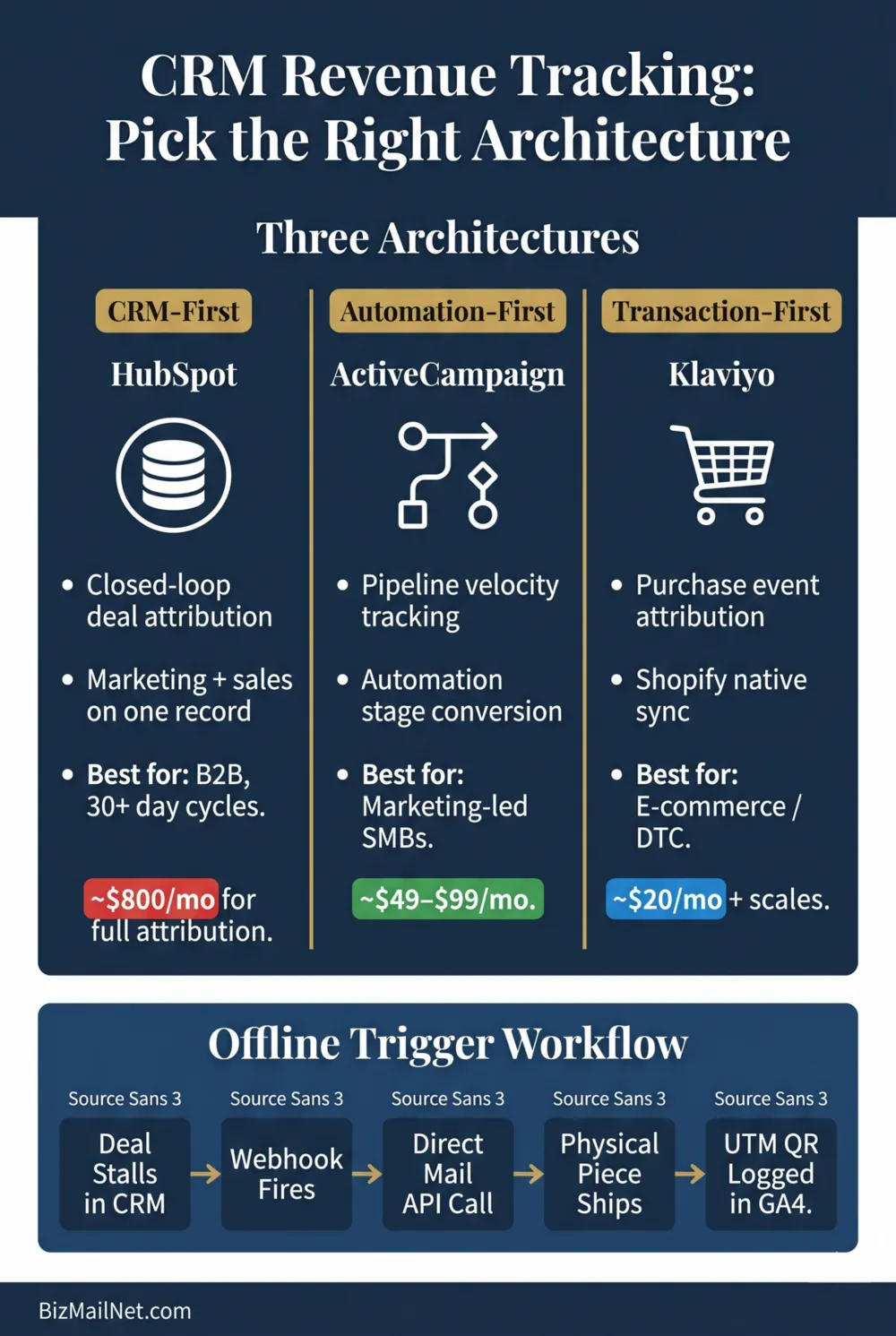
CRM-first tracking (HubSpot) ties marketing email activity to deal records. You can pull a closed deal and see every email touchpoint that preceded it, because the marketing data and the sales data live on the same contact record in the same database. This is closed-loop attribution in the technical sense of the phrase.
Automation-first tracking (ActiveCampaign) measures revenue through sales pipeline velocity and conversion rates at each automation stage. You can see how many contacts entered a given sequence, how many moved to the next stage, and how many converted to a sale. You cannot always see which specific email caused a specific deal to close, because the CRM object relationships are less rigid than HubSpot's native data model.
Transaction-first tracking (Klaviyo) ties email activity to purchase events. An email drives an abandoned cart recovery, a click results in a purchase, the purchase revenue gets credited to the email. This is the right model for e-commerce. It is the wrong model for a B2B consulting firm trying to trace a six-month sales cycle back to the first nurture email.
The correct selection process is not reading feature lists. It is identifying whether your business tracks revenue as a pipeline of deals, a sequence of transactions, or a series of automated qualification stages, and then finding the platform whose data model was designed for that structure.
HubSpot: CRM-First Revenue Tracking
HubSpot's data model is built around a contact-centric relational database. Every marketing email, sales email, deal stage change, and closed-won event is recorded on the same contact timeline. When a deal closes, you can open the contact record and scroll back through every touchpoint: the initial form submission, the first nurture email that got a click, the case study page visit, the demo email invitation, the follow-up sequence. Attribution is native to the platform rather than a bolt-on analytics layer.
This architecture makes HubSpot the right choice for multi-stakeholder B2B sales cycles where the gap between first email contact and closed deal spans weeks or months. The platform handles the complexity of tracking influence across a long, non-linear journey in a way that standalone email platforms and CRM integrations stitched together through Zapier cannot reliably replicate.
Cost Reality
The closed-loop attribution that makes HubSpot valuable lives in Marketing Hub Professional, which starts at approximately $800 per month. Below that tier, the attribution capabilities are materially limited. A practitioner on r/CRM noted that their employer pays over $19,000 per year for HubSpot, with an additional $15,000 in contact tier overages, prompting a search for alternatives. That experience is common enough to be treated as a planning assumption rather than an outlier.
Year-one costs for a team moving from a basic email tool to HubSpot Professional should budget for the platform fee, the mandatory onboarding fee (typically $3,000 or more), and the contact tier cost at their current list size. Teams with contact databases above 50,000 will often find the contact tier pricing pushes annual costs well above $20,000 before any additional seat licenses are added.
Who HubSpot Is For
B2B service companies, SaaS businesses, and professional services firms with multi-stakeholder sales cycles lasting 30 days or more. Teams that need a shared system of record where marketing and sales are looking at the same contact timeline. Organizations where "which email influenced this deal" is a question that gets asked in quarterly reviews and needs to have a defensible answer.
Who HubSpot Is Not For
E-commerce brands with high contact volumes and short purchase cycles. Teams with annual email marketing budgets under $15,000 where the platform cost takes too large a share. Businesses with straightforward automation needs that do not require closed-loop CRM attribution. Those teams are overpaying for capabilities they will not use.
ActiveCampaign: Automation-First Revenue Tracking
ActiveCampaign's architecture is an automation engine with a CRM attached rather than a CRM with marketing attached. This distinction determines what revenue tracking looks like in the platform. ActiveCampaign excels at measuring where contacts fall out of a sequence, which automation stages convert at the highest rates, and how pipeline velocity changes when different email sequences are in play. What it does less well than HubSpot is native closed-loop attribution on individual deal records, because its data model is workflow-centric rather than object-centric.
Practitioners summarize the difference plainly: ActiveCampaign is an email tool that added a CRM. HubSpot is a CRM that added email. Both descriptions are slightly reductive, but they capture the architectural priority that determines what revenue data is available natively versus what requires custom setup.
Cost Reality
ActiveCampaign's Lite tier starts at $9 per month. Full automation depth with CRM capabilities begins at the Plus tier, which runs $49 to $99 per month depending on contact count. The Professional tier with predictive AI features sits at $149 to $249 per month at standard list sizes. These figures represent a fraction of HubSpot Professional pricing while covering most of the same automation depth for marketing-led teams.
Analysts at Prospeo are direct about the positioning: ActiveCampaign wins for marketing-first teams under five people who need deep automation without tier-gating. HubSpot wins for larger teams requiring strict sales and marketing alignment within a single unified database. That framing holds up across the practitioner community.
Who ActiveCampaign Is For
Marketing-led SMBs where the majority of the revenue tracking question is "how is our automation sequence performing" rather than "which specific email influenced deal 4721." Teams that want conditional automation depth without HubSpot's contact-tier pricing model. B2B teams with sales cycles under 90 days where pipeline velocity metrics are sufficient without granular per-deal attribution.
Klaviyo: Transaction-First Revenue Tracking
Klaviyo's revenue tracking model is tied to shopping events. A contact abandons a cart, a flow fires, the contact clicks the email and completes the purchase, the purchase value is attributed to the flow. Predictive lifetime value calculations, post-purchase sequence revenue, browse abandonment recovery, and product recommendation click-through revenue are all native to the platform in ways that HubSpot and ActiveCampaign simply do not support out of the box.
This makes Klaviyo the strongest choice for e-commerce and DTC brands using Shopify or WooCommerce. The Shopify data connector syncs purchase history, cart events, and browse behavior into Klaviyo contact records in real time. An abandoned cart flow that fires within 30 minutes of a cart event is only possible when the event data arrives with that latency and triggers an automation that knows what specific products were in the cart.
Trying to use Klaviyo to track a complex B2B sales cycle produces fragmented attribution and lost pipeline visibility. There is no deal stage object. There is no multi-stakeholder contact association. The revenue tracking that works brilliantly for an abandoned cart flow does not translate to a six-month enterprise sales cycle involving four stakeholders, a procurement review, and a legal sign-off. Teams that select Klaviyo for B2B typically find they can measure email engagement metrics but cannot connect them to actual deal closure without a separate CRM.
Cost Reality
Klaviyo starts at $20 per month for up to 500 active profiles and scales by active profile count. For e-commerce brands, this contact-based pricing is reasonable because the platform's automation depth generates measurable purchase revenue that dwarfs the platform cost. The $1.94 average revenue per recipient from behavioral flows documented in Klaviyo's own benchmark report puts the cost-to-output ratio in a different category from platforms where email is not the primary purchase driver.
Who Klaviyo Is For
Shopify and WooCommerce brands where email automation drives a measurable share of purchase events. DTC companies where abandoned cart, post-purchase, and browse abandonment flows account for the majority of email-attributed revenue. E-commerce teams where the revenue tracking question is "which email drove which purchase" rather than "which email influenced which deal."
Platform Architecture Comparison
| Dimension | HubSpot | ActiveCampaign | Klaviyo |
|---|---|---|---|
| Primary architecture | CRM-first relational database | Automation-first workflow engine | Transaction-first event database |
| Revenue tracking mechanism | Closed-loop deal attribution on contact records | Pipeline velocity and automation stage conversion | Purchase event attribution via Shopify sync |
| Best business model match | B2B multi-stakeholder, long sales cycle | Marketing-led SMB, sub-90-day cycle | E-commerce, DTC, Shopify brands |
| Starting price for full attribution | ~$800/mo (Marketing Hub Professional) | ~$49–$99/mo (Plus tier) | ~$20/mo (scales by active profiles) |
| Year-one cost reality | $13,000+ including onboarding | $600–$1,200 at SMB scale | $240–$600 at SMB contact volumes |
| Native deal stage pipeline | Yes: full CRM pipeline | Yes: automation-based pipeline | No: purchase events only |
| Shopify abandoned cart tracking | Limited (requires integration) | Available via Shopify connector | Native, real-time |
The practitioner consensus from r/CRMSoftware frames the comparison plainly: the number one complaint among users is choosing the wrong tool for the job. Buying a CRM designed for sales and expecting it to handle high-volume consumer marketing data produces systemic failure. Buying an e-commerce automation platform and expecting it to track a complex enterprise sales cycle produces the same result in the opposite direction.
For teams currently evaluating which platform to move to, the email A/B testing sample sizes guide covers how to measure the output of whichever platform you land on, because the A/B test methodology that produces valid results does not change based on which tool is running the send.
Offline Triggers From CRM Deal Stages
Both HubSpot and ActiveCampaign support webhook automations that fire when a deal stage changes. This creates a direct bridge between digital CRM data and physical direct mail without any manual handoff.
The use case most teams have not built yet: a deal that stalls at a specific pipeline stage triggers a physical piece of mail to the prospect's office. Not a generic follow-up email that arrives in the same inbox the prospect has been ignoring. A physical postcard, a printed case study packet, or a branded package that arrives on the desk and costs nothing in email deliverability terms because it is not going through the inbox at all.
How the HubSpot Webhook Workflow Works
Create a workflow in HubSpot triggered by a deal property change. The trigger condition is "Deal stage becomes Stalled" or whatever stage name your pipeline uses for deals that have gone quiet. Add a webhook action that sends a POST request to the direct mail vendor's API endpoint. Lob and PostGrid both expose REST APIs that accept a contact name, mailing address, and template ID in the request payload. The vendor's system processes the request and ships the piece.
The cost of the physical piece, pulled from the vendor's API response, can be logged back to the deal record as a custom deal property. The deal record then shows both the email touchpoints that preceded the stall and the direct mail cost incurred to restart the conversation. This is a complete, attributed offline-digital hybrid workflow running without manual intervention.
How the ActiveCampaign Version Works
In ActiveCampaign, the same logic runs through a deal automation. Set a trigger on deal stage tag change within the CRM module. Add a webhook action to the automation that fires the same POST request to the direct mail vendor API. ActiveCampaign's webhook action supports custom headers and payload body, so the contact's mailing address fields can be passed directly from the contact record into the request body without a third-party connector.
For teams that want to close the attribution loop in GA4, each physical piece should carry a UTM-tagged QR code or vanity URL. When the prospect scans or types the URL, the resulting session appears in GA4 attributed to the direct mail piece, connected back to the same campaign timeline as the preceding email sequence.
The direct mail vendors that support webhook-triggered print-and-ship with REST APIs at SMB scale are reviewed in the direct mail follow-up directory.
Revenue Attribution Wizard
Answer three questions about your business model. The wizard outputs which platform architecture produces accurate revenue tracking for your specific situation, with the reasoning behind the recommendation.
FAQ
HubSpot's free CRM tracks contact activity and basic marketing interactions, but full closed-loop email revenue attribution requires Marketing Hub Professional at approximately $800 per month. Below that tier, you see email engagement data but lack the deal-stage and revenue attribution that makes HubSpot's tracking its core value. Teams on the free tier or Starter plan are effectively using HubSpot as a contact database with email sending, not as a closed-loop attribution platform.
Klaviyo is built for e-commerce transaction tracking. Its revenue attribution model is tied to shopping events: cart additions, abandoned checkouts, and purchases. For B2B organizations with long sales cycles and deal stage pipelines, Klaviyo lacks the native CRM object relationships needed to trace a closed deal back to an email touchpoint from months earlier. B2B teams that select Klaviyo typically find they can measure email engagement but cannot connect it to actual deal closure without a separate CRM running alongside.
Closed-loop attribution means tracing a closed sale all the way back to the marketing touchpoints that influenced the buyer before the deal closed. In email terms: knowing that the contact who signed a contract in month six first opened a nurture email in month one, clicked a case study link in month three, and attended a webinar triggered by a month-four email. HubSpot achieves this natively because marketing, sales, and deal data all live on the same contact record. Klaviyo achieves it only for e-commerce purchase events, not for B2B pipeline deals.
Marketing Hub Professional starts at approximately $800 per month for 3 seats and 2,000 marketing contacts. A team of five with 50,000 contacts can expect costs exceeding $1,500 to $2,000 per month for Marketing Hub Professional alone. Practitioners on r/CRM have reported annual costs exceeding $19,000 per year including contact tier charges. The mandatory onboarding fee for Professional and Enterprise adds $3,000 or more to year-one costs. Teams whose primary need is marketing automation rather than CRM-centric closed-loop attribution should evaluate ActiveCampaign first.
In HubSpot, create a workflow triggered by deal stage change and add a webhook action that sends a POST request to a direct mail vendor API (Lob and PostGrid both support this). The payload includes the contact's mailing address from the CRM record. The vendor processes the request and ships the piece. In ActiveCampaign, the same logic runs through a deal automation using the webhook action. Each physical piece should carry a UTM-tagged QR code so any resulting website visit appears in GA4 attributed to the direct mail piece alongside the preceding email sequence data.
Sources
- ActiveCampaign. Email Marketing and Automation Revenue Growth Data. 2026. activecampaign.com (vendor source)
- DigitalSyncNow. HubSpot vs ActiveCampaign vs Klaviyo: Pricing and Feature Comparison 2026. 2026. digitalsynnow.com (vendor source)
- Hustler Marketing. Klaviyo for E-Commerce: Revenue Attribution Deep Dive. 2026. hustlermarketing.com (vendor source)
- Prospeo. CRM and Email Platform Selection Guide 2026. 2026. prospeo.io (vendor source)
- Reddit. r/CRM. HubSpot pricing complaints thread. 2026. reddit.com (anecdotal)
- Reddit. r/CRMSoftware. Wrong tool for the job: platform mismatch discussion. 2026. reddit.com (anecdotal)